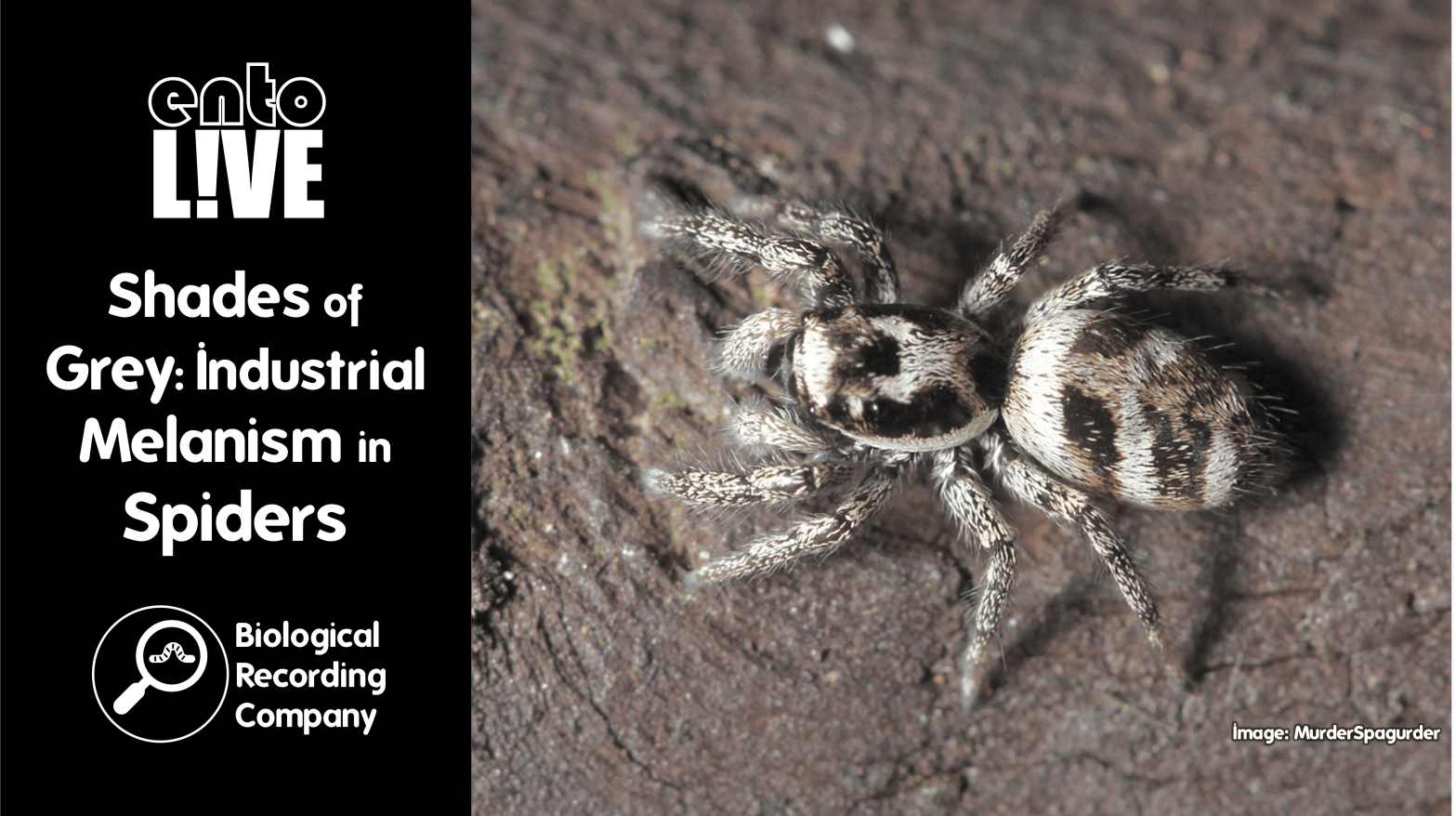
Industrial melanism refers to the phenomenon whereby some invertebrates evolved dark (melanic) forms in response to the darkening by soot of their resting surfaces during the Industrial Revolution. This response provided a clear example of Darwin’s ‘evolution by natural selection’ and was particularly well studies in moths. In this webinar Geoff will reappraise three claimed examples of industrial melanism in spiders and draw conclusions as to whether they constitute genuine exemplars of the phenomenon.
Q&A with Dr Geoff Oxford
Dr Geoff Oxford taught genetics and evolution at the University of York for nearly 40 years. His research largely focusing on (a) the adaptive significance of colour polymorphisms in spiders, and (b), speciation and hybridization in Large House spider species. He was a past president of the British Arachnological Society and is currently Hon. Secretary.
1. E.B. Ford famously tested how the camouflage provided by the Peppered Moth’s melanic form affected predation of the moth by birds. To do this he pinned moths on different backgrounds and counted how many were detected and eaten. Has any parallel study been conducted on melanic spiders?
No – and unfortunately the window of opportunity to conduct such workhas now passed because we don’t see melanic spiders anymore! As I discussed in the talk, the environment in which the melanic spiders were once found has changed dramatically since the Industrial Revolution. Buildings that were once blackened with soot are now squeaky clean again. The melanic form of the Peppered Moth is now extremely rare even in historically industrial regions. A similar fate likely befell the melanic forms of these spiders. Even if there are rare melanic specimens still hanging on, it’s unlikely they are a common enough phenotype to conduct tests on, at least in Britain. Whilst industrial melanism is now considered an effectively historical phenomenon in this country, other regions around the world are only just beginning, or in the middle, of their own industrial revolutions. India, for example, is currently going through extensive industrialisation, and many areas are burning large quantities of coal fuel. As in Britain in the 1800s, buildings will be blackened with soot and polluted by SO2. It would be very interesting to know if any Indian arachnologists are aware of industrial melanic species in situ in the present day.
2. How many generations does it take for a moth or spider to reach ‘full melanism’? Presumably it develops gradually?
Because melanism usually arises from a single dominant mutation, the first individual carrying the mutation will be melanic to some degree. However, after the original jump to melanism, so-called ‘modifier genes’ (multiple genes each with a small effect) can amplify the melanic phenotype, making it even darker. Bernard Kettlewell, a pioneer lepidopterist who studied industrial melanism in moths, compared early museum specimens of the melanic form of the Peppered Moth and noticed they were less dark than specimens he caught in the 1950s, meaning after the first major mutation, additional genetic changes were selected for that enhanced the melanic phenotype.
3. What’s the distinction between micro-evolution and adaptation?
Essentially they’re the same thing. Adaptation occurs as the result of changes of gene frequencies in populations. That’s what’s happened with some of these spiders and the Peppered Moth – the melanic form became advantageous in polluted environments and so increased in frequency.
4. Might epigenetics be involved in the story of industrial melanism?
Epigenetics refers to the phenomenon whereby the external environment affects the expression of genes in organism, an effect that can transcend generations. It is possible that this phenomenon was involved in industrial melanism – but we don’t know. This branch of genetics is relatively young and only emerged long after the original work on industrial melanism was conducted.
5. Do you think there might be any more undiscovered examples of industrial melanism hiding in existing museum collections?
It’s certainly possible – the only reason I was able to publish my review of industrial melanism in the three spider species discussed today was because specimens had ended up at the Manchester Museum, where entomology collections are well curated and catalogued. In other, less well organised collections, there may well be discoveries still waiting to be made.
Literature References
- Oxford (2025) ‘Industrial melanism in spiders: A reappraisal’: https://www.researchgate.net/publication/397141942_Industrial_melanism_in_spiders_a_reappraisal
- Ford (1975) ‘Ecological genetics’. 4th edition. London: Chapman & Hall.
- Kettlewell (1973) ‘The evolution of melanism: The study of a recurring necessity, with special reference to industrial melanism in the Lepidoptera’. London: Clarendon Press
- Majerus (1998) ‘Melanism – evolution in action’. Oxford: Oxford University Press
- Lees (1981) ‘Industrial melanism: genetic adaptation of animals to air pollution’. In Bishop and Cook (eds.), ‘Genetic consequences of man made change’. London: Academic Press: 341–352
- Bell et al. (2004) ‘A retrospective assessment of mortality from the London smog episode of 1952: the role of influenza and pollution’: https://pmc.ncbi.nlm.nih.gov/articles/PMC1241789/
- Cook et al. (2005) ‘Melanic moth frequencies in Yorkshire, an old English industrial hot spot’:https://academic.oup.com/jhered/article-abstract/96/5/522/2187664?redirectedFrom=fulltext
- Mackie (1964) ‘A melanic form of Salticus scenicus (Clerck)’. British Spider Study Group Bulletin 24: 4
- Mackie (1965) ‘An enquiry into the habits of Drapestica socialis (Sund.)’. British Spider Study Group Bulletin 27: 4–6
- Arnold and Crocker (1967) ‘Arctosa perita (Latr.) from colliery spoil heaps in Warwickshire and Leicestershire’ British Spider Study Group Bulletin 35: 7–8
Further Info
- British Arachnological Society (BAS): https://britishspiders.org.uk/
entoLIVE
entoLIVE webinars feature guest invertebrate researchers delving into their own invertebrate research. All events are free to attend and are suitable for adults of all abilities – a passion for invertebrates is all that’s required!
- Donate to entoLIVE: https://www.gofundme.com/f/entolive-2025
- Upcoming entoLIVE webinars: https://www.eventbrite.com/cc/entolive-webinars-74679
- entoLIVE blog: https://biologicalrecording.co.uk/category/entolive-blog/
- entoLIVE on YouTube: https://youtube.com/playlist?list=PLuEBNUcfMmE95Re19nMKQ3iX8ZFRFgUAg&feature=shared
entoLIVE is delivered by the Biological Recording Company in partnership with the British Entomological & Natural History Society, Royal Entomological Society and Amateur Entomologists’ Society, with support from Buglife.
The entoLIVE programme is delivered by Biological Recording Company and receives sponsorship from the following organisations:
- British Entomological & Natural History Society
- Royal Entomological Society
- Amateur Entomogists’ Society
Learn more about British wildlife
 Biological Recording