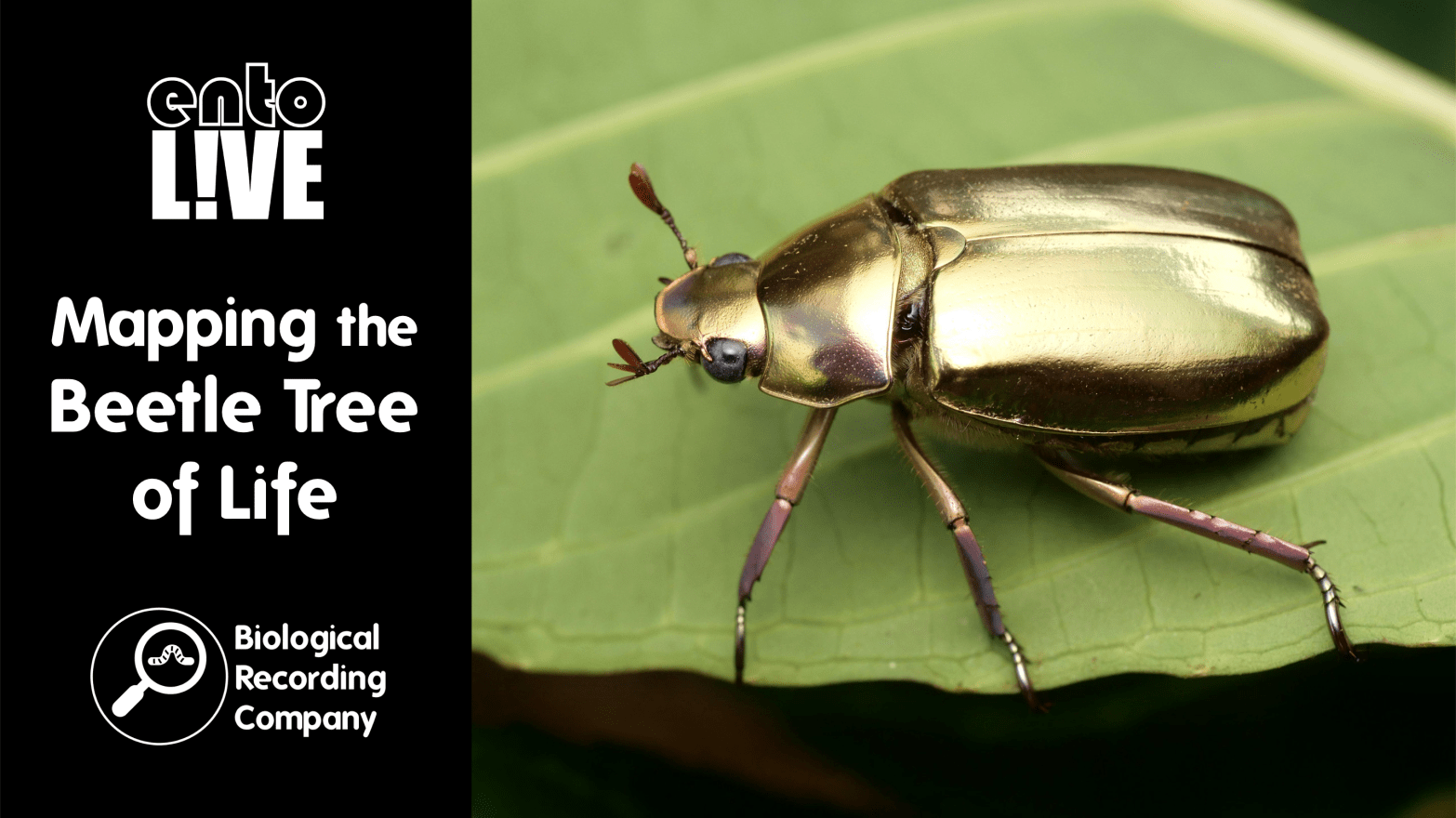
With over 400,000 described species, Coleoptera represent one of the most diverse groups of organisms on Earth, necessitating a global, integrative approach to understanding their evolutionary history. This effort begins with standardised field collection, specimen imaging, and identification, followed by high-quality DNA extraction. By combining genomic, mitochondrial, and barcode data, we are building the most comprehensive Coleoptera phylogeny to date – spanning over 100,000 species, including many that remain undescribed. This large-scale phylogenetic framework enables us to move beyond species counts, revealing global patterns of biodiversity through time and space and providing essential insights into species loss and the broader consequences of global change.
🎓 Check out our Beetles online course bundle: https://courses.biologicalrecording.co.uk/bundles/beetles
Q&A with Dr Beulah Garner
Dr Beulah Garner is a Senior Curator of Entomology at the Natural History Museum, London, where she oversees the collections of Orthopteroid insects and their allies. A specialist in beetles, her research focuses particularly on the evolutionary origins of ground beetles (Carabidae). In addition to her curatorial and research work, she serves as Chair of the Coleopterists Society of Britain and Ireland, supporting the advancement of beetle studies across the region.
How necessary is it to collect (and therefore kill) so many beetle specimens for a project like this, especially considering some of the species may be rare?
This is an important question which comes up a lot. My general response is this – how could we possibly go about this sort of research without collecting specimens? Technology may be rapidly evolving, but there’s currently no other methodology out there which can gather fine-scale, species-level data on distribution and diversity besides specimen collection. I personally struggle to imagine that such a technology – non-invasive, non-destructive and yet capable of gathering species-level data – ever could exist. And yet we must gather this data somehow because this research is so important. Not only does it provide insights into fundamental scientific questions – such as the origin and evolution of life on Earth – but it scaffolds the taxonomic backbone around which all invertebrate conservation is based. If we want to conserve invertebrate diversity, we must first understand invertebrate diversity, and currently there’s no feasible way to do that without collecting specimens. So, to answer, the question, it’s completely necessary. If there was any feasible alternative that didn’t involve killing beetles – we would obviously do that instead!
🎓 Surveying For Beetles online training course: https://courses.biologicalrecording.co.uk/courses/surveying-for-beetles
Why exactly have beetles been so successful at diversifying and speciating?
There are several factors involved. Most straightforwardly, beetles have been around for a long time. Current estimates suggest they first evolved in the early Permian, 295-300 million years ago – so they’ve had a lot of time to diversify! A more interesting dimension of the explanation is that beetles have displayed, and continue to display, a fantastic ability to diversify into both generalists and specialists. Both life strategies have proven to be successful in nature, and both can independently generate amazing radiations of species. In Coleoptera, both strategies are being harnessed independently, resulting in speciation on huge scales. The generalist life strategy works because it provides species with resilience against environmental change. As per the Darwinian ‘survival of the fittest’ principle; adaptability to newly available ecological niches is the key determinant of the evolutionary success of a lineage of species. Generalists are masters of this.
For example, in the family I work mostly on – the Carabidae or ground beetles – there are thousands of generalist species capable of surviving in a range of habitats and consuming a variety of prey. On the other side of the spectrum, taking this to the other extreme, many beetles are instead specialists. Weevils (superfamily Curculionoidea), for example, include tens of thousands of species which are specialised to feed on single host plant species. What this life strategy foregoes in terms of resilience to environmental change it makes up for in resilience against competition from other species. Again, this provides robustness against threat of extinction and drives diversification.
Does preparing a beetle for DNA extraction involving destroying the specimen?
Not anymore! But in the past, yes. In fact, in the early days of DNA extraction you’d have to literally grind up the specimen to prepare it, meaning no voucher specimen to link to the sample. That then progressed to just removing a single leg, or a section of flight muscle, from the specimen to prepare for DNA extraction. Nowadays we don’t even need to do that. You can simply bathe a specimen in what’s called a ‘lysing solution’, the DNA will be extracted overnight, and the specimen should be able to be taken, unaltered from the liquid afterwards, and incorporated into a dry pinned collection or to a molecular collection facility in preservation fluid.
🎓 Unlocking Invertebrate Genomes: Trying to Sequence Every Species entoLIVE blog: https://biologicalrecording.co.uk/2023/04/13/sequencing-invertebrates/
Have there been any efforts to link the findings of the Site-100 project to the existing collections at the museum?
Linking the molecular and voucher specimens from Site-100 to existing collections at the NHM would be amazing, but sadly it is outside the scope of our current team. It would take a considerable amount of time and money and personnel to complete such a task. We cannot feasibly consider starting on it as things currently stand. I would hope, however, that in the future such work might be undertaken. We are preserving and digitising the Site-100 collection in such a way that it can hopefully continue to be worked on decades to centuries into the future. Sadly at that point many of the undescribed species we’ve collected may well have already gone extinct.
Literature References
- Parisi et al. (2020) ‘Diversity patterns of Coleoptera and saproxylic communities in unmanaged forests of Mediterranean mountains’: https://www.sciencedirect.com/science/article/abs/pii/S1470160X19308684
- Bouchard et al. (2011) ‘Family-group names in Coleoptera (Insecta)’: https://zookeys.pensoft.net/article/4001/
- Harris et al. (2019) ‘Decline in beetle abundance and diversity in an intact temperate forest linked to climate warming’: https://www.sciencedirect.com/science/article/pii/S0006320719310572
- Garner et al. (2024) ‘The taxonomic composition and chronology of a museum collection of Coleoptera revealed through large-scale digitisation’: https://www.frontiersin.org/journals/ecology-and-evolution/articles/10.3389/fevo.2024.1305931/full
- Erwin (1991) ‘How Many Species Are There?: Revisited’: https://www.jstor.org/stable/2385903
- Strasser (2008) ‘GenBank–Natural History in the 21st Century?’: https://www.science.org/doi/10.1126/science.1163399
- Bian et al. (2022) ‘The SITE-100 Project: Site-Based Biodiversity Genomics for Species Discovery, Community Ecology, and a Global Tree-of-Life’: https://www.frontiersin.org/journals/ecology-and-evolution/articles/10.3389/fevo.2022.787560/full
- Creedy et al. (2025) ‘Bioinformatics of Combined Nuclear and Mitochondrial Phylogenomics to Define Key Nodes for the Classification of Coleoptera’: https://academic.oup.com/sysbio/advance-article-pdf/doi/10.1093/sysbio/syaf031/65497055/syaf031.pdf
Further Info
- Chafer Beetles of the UK online course: https://courses.biologicalrecording.co.uk/courses/chafers
- Longhorn Beetles of the UK online course: https://courses.biologicalrecording.co.uk/courses/longhorn-beetles
- About Dr Beulah Garner: https://www.nhm.ac.uk/our-science/people/beulah-garner.html
- Coleopterists Society: https://www.colsoc.org/
- Darwin’s fondness for beetles: https://economictimes.indiatimes.com/us/news/charles-darwins-love-for-beetles-inspired-a-breakthrough-in-biology/articleshow/128261336.cms?from=mdr
- The Natural History Museum’s Coleoptera collections: https://www.nhm.ac.uk/our-science/services/collections/entomology/coleoptera.html
- The Insect Crisis by Oliver Milman: https://atlantic-books.co.uk/book/the-insect-crisis/
- Natural History Museum London data portal: https://data.nhm.ac.uk/
- The Red list of Insect Taxonomists: https://red-list-taxonomists.eu/
- Convention on Biological Diversity: https://www.cbd.int/
- Terry Erwin Obituary: https://ibol.org/barcodebulletin/illuminations/30-million-reasons-you-will-be-missed/
- SITE100 project: https://www.site100.org/
- Vogler Lab: https://profiles.imperial.ac.uk/a.vogler
- SITE100 FLICKR: https://www.flickr.com/photos/site-100/albums/
- SITE100 iNaturalist Project: https://www.inaturalist.org/projects/site100
- Natural History Museum Entomology: https://www.nhm.ac.uk/our-science/services/collections/entomology.html
- Panama Wildlife Conservation panamawildlife.org
- UNAM Biology: https://www.ib.unam.mx/ib/ssb2023/
- YOLO v8: https://yolov8.com/
- How many insects are there?: https://www.royensoc.co.uk/understanding-insects/facts-and-figures/
entoLIVE
entoLIVE webinars feature guest invertebrate researchers delving into their own invertebrate research. All events are free to attend and are suitable for adults of all abilities – a passion for invertebrates is all that’s required!
- Donate to entoLIVE: https://www.gofundme.com/f/entolive-2025
- Upcoming entoLIVE webinars: https://www.eventbrite.com/cc/entolive-webinars-74679
- entoLIVE blog: https://biologicalrecording.co.uk/category/entolive-blog/
- entoLIVE on YouTube: https://youtube.com/playlist?list=PLuEBNUcfMmE95Re19nMKQ3iX8ZFRFgUAg&feature=shared
entoLIVE is delivered by the Biological Recording Company in partnership with the British Entomological & Natural History Society, Royal Entomological Society and Amateur Entomologists’ Society, with support from Buglife, Field Studies Council and National Biodiversity Network Trust.
The entoLIVE programme is delivered by Biological Recording Company and receives sponsorship from the following organisations:
- British Entomological & Natural History Society
- Royal Entomological Society
- Amateur Entomogists’ Society
Learn more about British wildlife
 Biological Recording