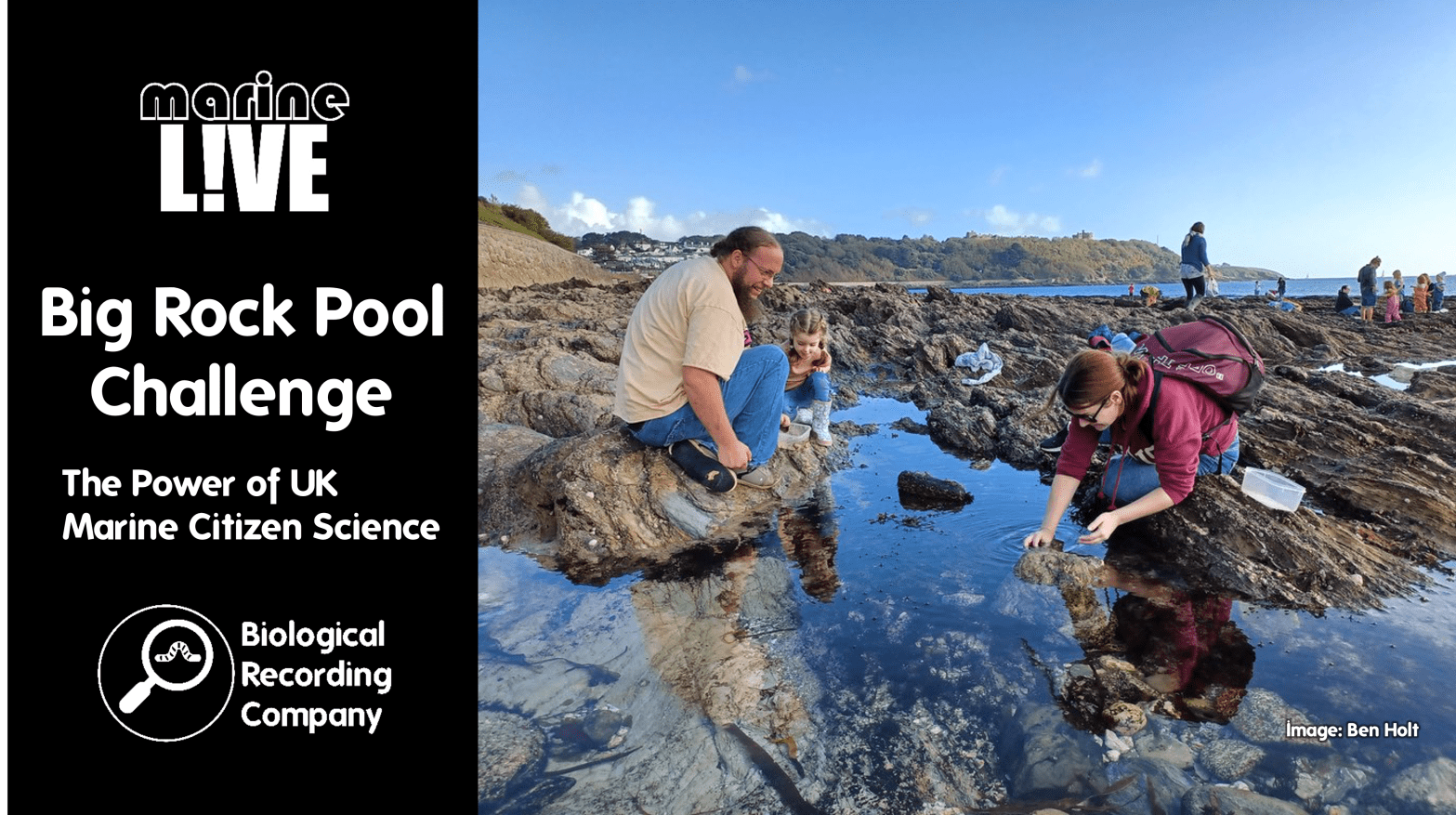
The Big Rock Pool Challenge is a nationwide citizen science initiative that invites people of all ages to explore their local coastlines and discover the remarkable wildlife hidden in rock pools. In this talk, Dr Ben Holt (CEO and co-founder of The Rock Pool Project) shares how the challenge blends hands-on marine exploration with digital tools to create a fun, accessible, and scientifically valuable experience for communities across the UK. From competitive BioBlitz battles to large-scale biodiversity recording, he reveals how the Challenge is transforming public engagement with the ocean and empowering thousands of volunteers to contribute meaningful data to marine conservation.
Q&A with Dr Ben Holt
Dr Ben Holt is a marine biologist and the CEO and co-founder of The Rock Pool Project, a UK social enterprise that connects people with the incredible wildlife of the coast through community science, education, and digital innovation. With a background in marine ecology and biogeography, Ben has spent his career exploring how people interact with the natural world and how technology can inspire large-scale participation in environmental research. Under his leadership, The Rock Pool Project has grown into a nationwide movement empowering thousands of volunteers to record and protect marine life through initiatives such as the Big Rock Pool Challenge. Ben is a passionate communicator who blends scientific expertise with creative outreach, helping to build stronger connections between people, technology, and the sea.
1. Do you have an idea what rough percentage of the species records recorded by participants on the bioblitzes are correctly identified upon submission?
I don’t have the exact numbers, but generally I’d estimate that about 90% of records are correctly identified upon submission. The 10% that are incorrect are a mixture of those which are (a) wrongly identified, or (b) not identifiable to as specific a taxonomic rank as the user originally suggested (e.g. user suggested species A, but it could also be species B in the same genus, so the record should be corrected to genus level). I mentioned in the talk that after each event we give participants a ‘score’ based on the combined rarity scores of all the species they’ve recorded. We stress, however, that this score they receive on the day is ‘provisional’. Their ‘real’ score is awarded later, in five days’ time, based on their species records which reach ‘Research Grade’ status on iNaturalist. By the end of that 5-day period my experience tells me that very few (<1%) of those Research Grade observations are incorrectly identified – the community is very good at catching errors.
2. Are the Big Rock Pool Challenge organisers also providing identifications for participants on iNaturalist?
Yes, this is part of the voluntary role of the organisers at each hub. The organisers are tasked with following up on the records generated in the 5-day period after each event and providing identifications. This involves a mixture of confirming the identification of correctly identified species, correcting the (usually small number of) incorrectly identified records, refining observations made at high taxonomic ranks to lower ranks where applicable, and sometimes bumping observations back up to higher ranks if the identification suggested is deemed too specific and not justified. In addition to the organisers, we also encourage participants to get involved with the identification if they feel confident doing so.
3. Are there plans to expand the number of Big Rock Pool Challenge ‘hubs’ across the country?
Yes – and if you would like to be involved in setting up a new hub we would love to hear from you! We’ve recently launched a new page on our website specifically for this, in fact, where you can register your interest. So far the Big Rock Pool Challenge is running at nine hubs across the country (you can see these on this map on our website). We would love to put any additional funding towards establishing more hubs. We are currently in the process of negotiating a third year of funding from Scottish Power, for example, and if successful with that we should be able to support fifteen new hubs across the UK launching towards the end of 2026. In addition to that, we have recently published guidance on setting up and running a ‘pilot’ Big Rock Pool Challenge bioblitz battle in your local area. If you like the idea of the challenge but aren’t sure if you want to commit to being a full ‘hub’ yet, I recommend checking this out. The guidance for ‘pilot events’ is on our website here.
4. How is this all funded?
Currently we are funded by grants from the Scottish Power Foundation and the National Lottery Heritage Fund – we are immensely grateful to these organisations. The challenge we have going forward is how to make our work financially sustainable in the long term. Grant funds are excellent, but they are preferentially directed towards establishing new projects rather than funding ongoing ones. We definitely do not want to scrap The Big Rock Pool Challenge and start something new; we want to keep this going and build it. The Rock Pool Project as an organisation has therefore recently applied to become a charity, transitioning away from its previous life as a non-profit Community Interest Company (CIC). We’ll be working on building a sustainable funding model as a charity over the coming year. If anyone has experience in the charity sector and would like to advise us, please do get in touch – I’d love to hear from you.
5. Have there been any publications based on your datasets?
Not yet, but we hope to see some in the future. Currently we’re still in the first few years of data collection at our sites, but as the temporal span of the data grows I imagine we will start registering some interesting trends in the fortunes of marine life around the British coast. At our principal hubs in Cornwall (Castle Beach and Mount Batten) we have already started anecdotally noticing temporal trends in populations of some species. There are 10–20 species which were rare when we first started that are now very common, for example. In addition to monitoring trends in common, native species we are also keen to be involved in the monitoring and detection of non-native marine species. To get the ball rolling on this, we’ve collaborated with Natural England to identify a group of non-native marine species which are of potential concern and are regularly sharing our data on these species onwards. Generally, any university researchers or students keen to use our dataset – please get in touch! We’d love to collaborate with you.
Literature References
- Holt et al. (2010) ‘Signatures of speciation? Distribution and diversity of Hypoplectrus (Teleostei: Serranidae) colour morphotypes’: https://onlinelibrary.wiley.com/doi/abs/10.1111/j.1466-8238.2010.00539.x
- Kesebir and Kesebir (2017) ‘A Growing Disconnection From Nature Is Evident in Cultural Products’: https://pubmed.ncbi.nlm.nih.gov/28346112/
- Mora et al. (2008) ‘The completeness of taxonomic inventories for describing the global diversity and distribution of marine fishes’: https://royalsocietypublishing.org/rspb/article-abstract/275/1631/149/66390
Further Info
- Big Rock Pool Challenge: https://www.therockpoolproject.co.uk/the-big-rock-pool-challenge
- The Big Rock Pool Challenge iNaturalist project: https://www.inaturalist.org/projects/the-big-rock-pool-challenge
- The Rock Pool Project: https://www.therockpoolproject.co.uk/
- Marine Biological Association: https://www.mba.ac.uk/
- DASSH: https://www.dassh.ac.uk/
- Reef: www.reef.org
- Rare rainbow sea slug found in Falmouth rock pool (BBC News article): https://www.bbc.co.uk/news/uk-england-cornwall-65594928
marineLIVE
marineLIVE webinars feature guest marine biologists talking about their research into the various organisms that inhabit our seas and oceans, and the threats that they face. All events are free to attend and are suitable for adults of all abilities – a passion for marine life is all that’s required!
- Upcoming marineLIVE webinars: https://www.eventbrite.co.uk/cc/marinelive-webinars-3182319
- Donate to marineLIVE: https://gofund.me/fe084e0f
- marineLIVE blog: https://biologicalrecording.co.uk/category/marinelive-blog/
- marineLIVE on YouTube: https://youtube.com/playlist?list=PLuEBNUcfMmE-t2dzcoX59iR41WnEf21fg&feature=shared
marineLIVE is delivered by the Biological Recording Company with funding from the British Ecological Society.
- Explore upcoming events and training opportunities from the Biological Recording Company: https://www.eventbrite.co.uk/o/the-biological-recording-company-35982868173
- Check out the British Ecological Society website for more information on membership, events, publications and special interest groups: https://www.britishecologicalsociety.org/
Learn more about British wildlife


 Biological Recording