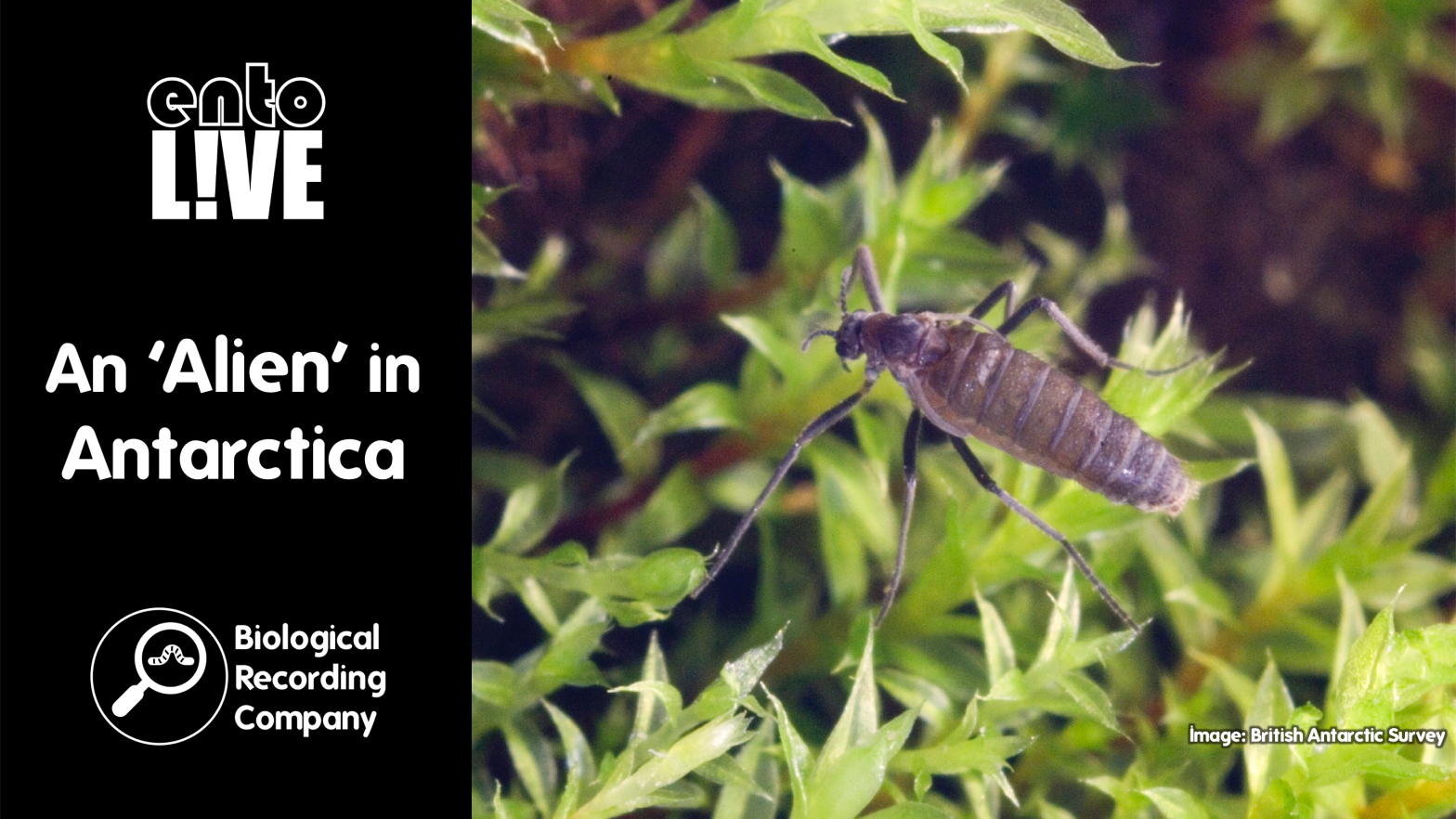
A tiny flightless midge, Eretmoptera murphyi, accidentally introduced to Antarctica in the 1960s, has spread across Signy Island and now dominates the soil ecosystem. Its larvae feed on dead plant material, enriching the soil with nitrogen and changing conditions in ways that could help other species invade. Octavia’s research reveals these midge-altered soils also release more greenhouse gases, meaning this small insect could be quietly accelerating climate change in one of the planet’s most fragile environments.
Q&A with Octavia Brayley
Octavia Brayley is a Ph.D. researcher at the University of Birmingham and British Antarctic Survey, principally investigating the ecological impacts of a non-native insect species on Signy Island, Antarctica. Her work integrates biogeochemistry and microbiology to assess environmental effects, recently expanding to the microbiomes and physiology of related insects in sub-Antarctic regions. Beyond research, Octavia was the previous co-head of education and outreach for the UK Polar Network, and hosts the Polar Diaries podcast.
1. Did you find a difference in the microbiology of soils with versus without Eretmoptera murphyi present?
This is a really interesting area for investigation, but sadly it was not something I was able to look into as part of my PhD. There have, however, been some previous studies that have looked at the microbiology of soils on Signy Island, and we did, as part of my research, identify a few groups of soil bacteria in Signy soils that hadn’t previously been documented. Whether or not these have anything to do with E. murphyi I cannot comment on. They may be commensal microorganisms which came along with E. murphyi, but more research would definitely be needed before drawing a conclusion. An exciting way to investigate this question would be to collect E. murphyi-associated soils from South Georgia island – its native environment – and compare them against soils from the same island but from places where E. murphyi is known to be absent. The difficulty with this is that it’s actually almost impossible these days to find E. murphyi on South Georgia! It seems to have practically disappeared. This may be linked to the introduction of a different non-native species to South Georgia – a predatory beetle – which feeds on E. murphyi there.
2. How effective are the biosecurity protocols on Antarctica these days?
In my opinion, the biosecurity protocols for scientists are currently not the best and sorely need to be updated. There is a specific chemical called Virkon which is currently used by Antarctic scientists to sanitise boots and equipment when landing on islands in and around Antarctica. A study was done a few years ago looking at how effective Virkon was at killing Eretmoptera murphyi. Turns out – even when dropped into a vat of the stuff – the midge survived. If E. murphyi can survive Virkon then it’s likely other hardy Antarctic invertebrates that might be introduced in the future can survive it too. I don’t know so much about how effective it is at sterilising plant seeds, but I would guess it’s also imperfect. Like invertebrates, the seeds of plants in this part of the world can be very robust. The biosecurity measures for tourists are, fortunately, a lot better. There are also very strict guidelines in place regarding which islands tourists can visit and whereabouts they can go on said islands. I suspect Peter Convey – giving another entoLIVE about Antarctic Invertebrates later this year in March – will have more to say on the topic of biosecurity too, if still of interest.
3. Why is increased nitrogen concentration in Antarctic soils a problem?
Great question. Increased nitrogen concentrations are actually not necessarily a problem, in the short-term at least. I personally hypothesise that the plants present on Signy Island (mosses and the like) and perhaps also some of the invertebrates might actually benefit from the higher nitrogen concentrations in the short-term. Higher nitrate levels means more nutrients for growth in plants, for example. I don’t expect terrible consequences immediately, by any means. What is concerning, however, is the long-term impact. If E. murphyi is boosting soil nitrogen on Signy Island currently, it is possible that this will open a window for more non-native species to establish in the future. Again, arrival of new species doesn’t necessarily mean negative consequences for the native wildlife, but there is a risk. Antarctic ecosystems are inherently fragile, so any upset to the natural balance is alarming.
4. Do you anticipate that there might be knock-on effects of elevated soil nutrients on some of the larger Antarctic animals?
Another interesting question. As far as I know, nobody has – so far – officially studied this topic in the Antarctic context. The larger Antarctic animals – famous things like penguins and seals, for example – do sometimes use terrestrial environments for part of their life cycle, but generally I wouldn’t expect a chemical change in soil conditions to affect them greatly. The most important parts of their lives are spent in the water, really. They are only really on land for mating and ‘chilling out’ (pun intended?). A slightly tangential fun fact, however, is that both penguins and seals do interact with terrestrial nutrient cycles in Antarctica through defecating; their poop creates ‘pulses’ of nutrient input to the terrestrial environment!
5. Does anything eat Eretmoptera murphyi?
Nothing on Signy Island, no, but there is a non-native predatory beetle found on South Georgia Island which eats the midge. Some people have suggested introducing that beetle to Signy Island too, but I am very skeptical of that being a good idea! History has given us plenty of examples of how introducing one species to control another has made things even worse than they originally were!
Literature References
- Bartlett et al. (2023) ‘Ecological consequences of a single introduced species to the Antarctic: Terrestrial impacts of the invasive midge Eretmoptera murphyi on Signy Island’: https://doi.org/10.1016/j.soilbio.2023.108965
- Bartlett et al. (2020) ‘An insect invasion of Antarctica: the past, present and future distribution of Eretmoptera murphyi (Diptera, Chironomidae) on Signy Island’: https://doi.org/10.1111/icad.12389
- Bartlett et al. (2021) ‘The effectiveness of Virkon® S disinfectant against an invasive insect and implications for Antarctic biosecurity practices’: https://doi.org/10.1017/S0954102020000413
- Bergstrom (2022) ‘Maintaining Antarctica’s isolation from non-native species’: https://doi.org/10.1016/j.tree.2021.10.002
- Brayley et al. (2025) ‘The microbiome of an invasive Antarctic insect, Eretmoptera murphyi (Diptera: Chironomidae), and its potential role in nutrient cycling’: https://doi.org/10.21203/rs.3.rs-7744438/v1
- Convey (2010) ‘Terrestrial biodiversity in Antarctica – Recent advances and future challenges’: https://doi.org/10.1016/j.polar.2010.03.003
- Hughes et al. (2015) ‘Biological invasions in terrestrial Antarctica: What is the current status and can we respond?’: https://doi.org/10.1007/s10531-015-0896-6
- Hughes et al. (2013) ‘The non-native chironomid Eretmoptera murphyi in Antarctica: erosion of the barriers to invasion’: https://doi.org/10.1007/s10530-012-0282-1
- Leihy et al. (2023) ‘Introduced and invasive alien species of Antarctica and the Southern Ocean Islands’: https://doi.org/10.1038/s41597-023-02113-2
- Pyšek et al. (2020) ‘Scientists’ warning on invasive alien species’: https://doi.org/10.1111/brv.12627
Further Info
- Antarctic Invertebrates: Diversity and Threats – upcoming entoLIVE webinar: https://www.eventbrite.co.uk/e/1914682529989
- BBC News article – ‘When aliens attack Antarctica’: https://www.bbc.co.uk/news/uk-england-46850414
entoLIVE
entoLIVE webinars feature guest invertebrate researchers delving into their own invertebrate research. All events are free to attend and are suitable for adults of all abilities – a passion for invertebrates is all that’s required!
- Donate to entoLIVE: https://www.gofundme.com/f/entolive-2025
- Upcoming entoLIVE webinars: https://www.eventbrite.com/cc/entolive-webinars-74679
- entoLIVE blog: https://biologicalrecording.co.uk/category/entolive-blog/
- entoLIVE on YouTube: https://youtube.com/playlist?list=PLuEBNUcfMmE95Re19nMKQ3iX8ZFRFgUAg&feature=shared
entoLIVE is delivered by the Biological Recording Company in partnership with the British Entomological & Natural History Society, Royal Entomological Society and Amateur Entomologists’ Society, with support from Buglife, Field Studies Council and National Biodiversity Network Trust.
The entoLIVE programme is delivered by Biological Recording Company and receives sponsorship from the following organisations:
- British Entomological & Natural History Society
- Royal Entomological Society
- Amateur Entomogists’ Society
Learn more about British wildlife
 Biological Recording