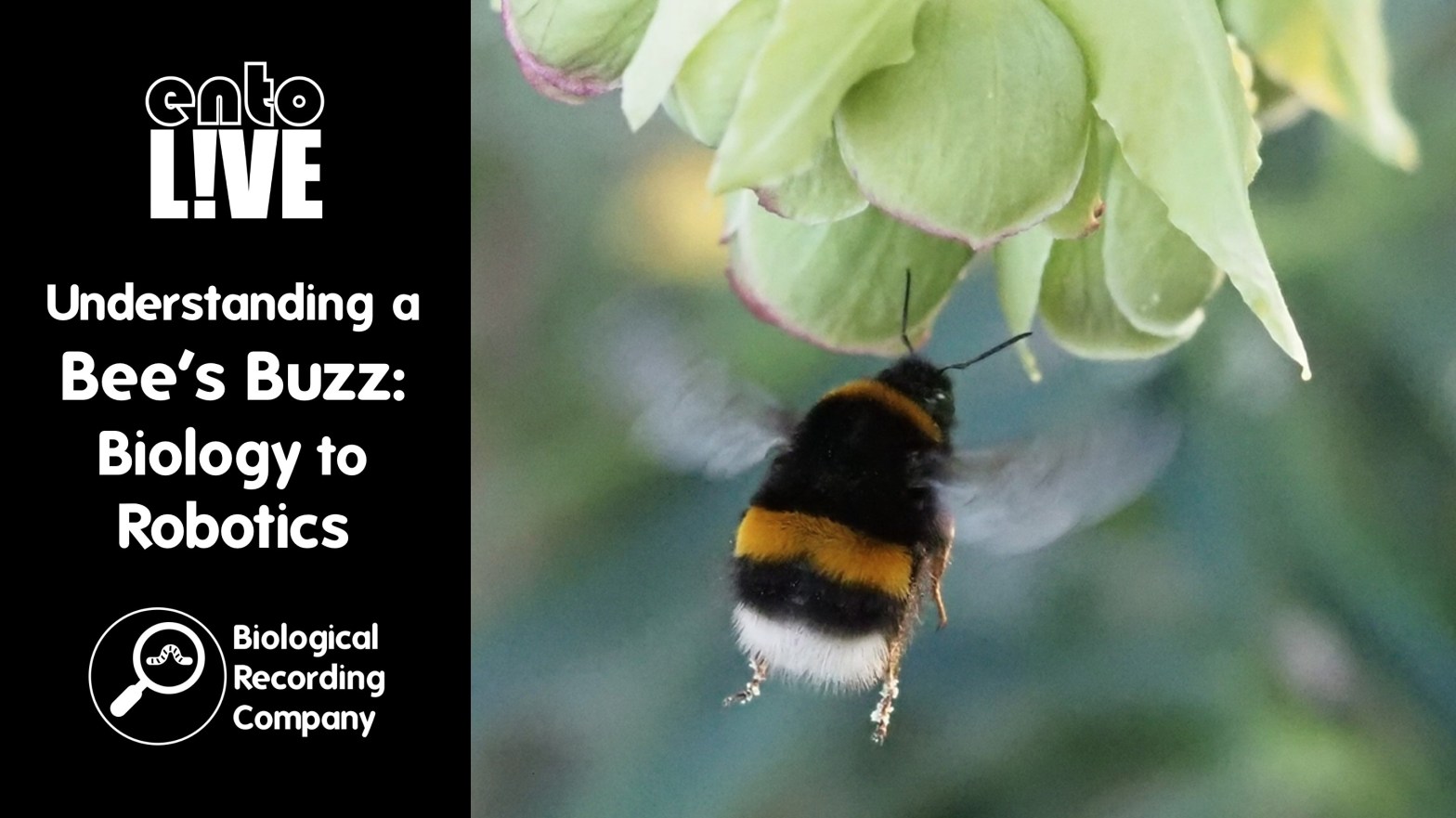
Ever wondered how and why bees buzz? Or what determines the different properties of a bee buzz? In this webinar, Charlie reveals the answer. Join us to understand bee buzzes through his work from the lab and field to understand how bees produce their buzzes and how this understanding is being used to inform the design of micro-robots for pollination.
Q&A with Dr Charlie Woodrow
Dr Charlie Woodrow is a Zoologist working at Uppsala University to understand the diversity of insects and how they work. In particular, he is interested in how insects produce and detect sounds and vibrations. This research has taken him to some of the most remote regions of the world in search of new and interesting insects and their behaviours, from hearing in crickets to how bees produce their buzzes. He combines this fieldwork with lab experiments, 3D imaging and computer models to understand the fine details of insect form and function.
1. Why can’t honey bees buzz pollinate?
Good question. It is actually estimated that only half of the world’s total bee species can buzz pollinate. Why can some do it others can’t? We don’t know! We think the answer is probably contextual; perhaps all bees could theoretically have evolved the ability to buzz pollinate, but they haven’t all needed to evolve, learn and exhibit this behaviour. That’s our best guess, but it’s an open area for research still. It’s also down to observation, maybe more bees can buzz pollinate than we know, but we haven’t observed it yet.
2. Why can’t honey bees buzz pollinate?
They’re completely spread out; buzz pollination is displayed in bees from several
disparate genera across multiple taxonomic families.
3. Are there different ‘sweet spots’ of wing position for flying versus buzz pollination?
Perhaps. In general, we know that when bees are flying their wings are fully extended and when they’re doing other non-flight behaviour their wings seem to be fully retracted. If we were to scrutinise this in further detail it’s likely we’d see variation in these wing positions which should certainly affect the types of buzz they produce, but it’s yet to be investigated and quantified.
4. What are the applications of buzzing micro-robots?
I want to make very clear that our goal with this research has never been to try and find a way to ‘replace’ real bees. We want to develop these micro-robots to
understand the different buzzes that bees produce and the functional diversity
therein. There are also some environments where artificial pollination services would be useful, for example large-scale industrial indoor greenhouses. We’re a long way off being able to fully mimic the pollination services of bees with robots, right now. Buzzing for pollen release is just the first part of the pollination role played by bees – there would also need to be a way to transport the pollen between flowers for fertilisation. Bees are obviously adept at this too, and this is a way off being paralleled by a micro-robot!
5. You mentioned that your micro-robots sometimes accidentally attracted pollen due to having a slight static charge. Do bees also utilise static electricity when foraging for pollen?
They absolutely do. We have some great high-speed video of pollen falling and
swinging round underneath a bee to attach to it. Bees are statically charged too!
6. Have you found much variation between bee species (or between individuals of the same bee species) in terms of the properties of the non-flight buzzes produced?
We haven’t found much variation so far. And that makes some sense; buzzes are
produced by a physiological mechanism which is thought to be more or less consistent across different bee species. We’re yet to observe any major structural differences in the thoracic muscles responsible for buzzing, for example. Any differences there are in the properties of the buzz between or within species seem to be determined by two things: (1) the size of the bee; and (2) the temperature. Some other factors might have a small influence, but from what we have observed so far, it’s primarily size and temperature.
7. Do bees disconnect their wings when buzz pollinating?
Not exactly, the fore-wings and hind-wings are still hooked together (bees do
this with tiny hooks called hamuli which run along the edges of the wings), just folded back.
8. Have you looked into the effects of weather on buzz pollination?
We haven’t comprehensively studied this yet, but we are kind of looking into it. At the lab at Uppsala University we have a very cool temperature-controlled chamber where we can vary parameters related to temperature and humidity and see how this affects the bees and their buzz. I highly suspect weather, particularly sun exposure and humidity, does have a strong effect on the properties of bee’s buzzes.
Charlie’s robot bee research was supported by a Human Frontier Research Grant (https://doi.org/10.52044/HFSP.RGP00432022.pc.gr.153603) awarded to Prof. Mario Vallejo Marin (Uppsala) and Prof. Noah Jafferis (UMass Lowell). Charlie’s temperature experiments are funded by a Birgitta Sintring Foundation grant awarded to Dr. Charlie Woodrow. To follow updates on these research grants, follow the Uppsala lab website (https://plant-evolution.org/wp/research/buzz-pollination/) and/or follow Charlie on Bluesky (@CharlieZoology).
Literature References
- Gau et al. (2023) ‘Bridging two insect flight modes in evolution, physiology and robophysics’: https://www.nature.com/articles/s41586-023-06606-3.pdf
- Josephson et al. (2000) ‘Asynchronous muscle: a primer’: https://journals.biologists.com/jeb/article-abstract/203/18/2713/8551/Asynchronous-Muscle-A-Primer
- Vallejo-Marín (2022) ‘How and why do bees buzz? Implications for buzz pollination’: https://pmc.ncbi.nlm.nih.gov/articles/PMC8866655/
- Ono et al. (1995) ‘Unusual thermal defence by a honeybee against mass attack by hornets’: https://www.nature.com/articles/377334a0
- Barron et al. (2017) ‘The evolution of honey bee dance communication: a mechanistic perspective’: https://www.researchgate.net/profile/Jenny-Plath/publication/321700270_The_evolution_of_honey_bee_dance_communication_A_mechanistic_perspective/links/5d51147b92851cd046b4d397/The-evolution-of-honey-bee-dance-communication-A-mechanistic-perspective.pdf
- Vallejo-Marin et al. (2024) ‘Biomechanical properties of non-flight vibrations produced by bees’: https://www.researchgate.net/profile/Daniel-Montesinos-2/publication/380784575_Biomechanical_properties_of_non-flight_vibrations_produced_by_bees/links/66750cb0d21e220d89c5239c/Biomechanical-properties-of-non-flight-vibrations-produced-by-bees.pdf
- Alcock (1996) ‘The relation between male body size, fighting, and mating success in Dawson’s burrowing bee, Amegilla dawsoni (Apidae, Apinae, Anthophorini)’: https://zslpublications.onlinelibrary.wiley.com/doi/abs/10.1111/j.1469-7998.1996.tb05469.x
- Woodrow et al. (2025) ‘Increasing temperatures affect thoracic muscle performance in Arctic bumblebees’: https://www.nature.com/articles/s41467-025-65671-6.pdf
- Woodrow et al. (2024) ‘Buzz-pollinating bees deliver thoracic vibrations to flowers through periodic biting’: https://www.cell.com/current-biology/fulltext/S0960-9822(24)00947-3?uuid=uuid%3A69b49095-3209-4f7e-820e-6caa3d3df334
entoLIVE
entoLIVE webinars feature guest invertebrate researchers delving into their own invertebrate research. All events are free to attend and are suitable for adults of all abilities – a passion for invertebrates is all that’s required!
- Donate to entoLIVE: https://www.gofundme.com/f/entolive-2025
- Upcoming entoLIVE webinars: https://www.eventbrite.com/cc/entolive-webinars-74679
- entoLIVE blog: https://biologicalrecording.co.uk/category/entolive-blog/
- entoLIVE on YouTube: https://youtube.com/playlist?list=PLuEBNUcfMmE95Re19nMKQ3iX8ZFRFgUAg&feature=shared
entoLIVE is delivered by the Biological Recording Company in partnership with the British Entomological & Natural History Society, Royal Entomological Society and Amateur Entomologists’ Society, with support from Buglife, Field Studies Council and National Biodiversity Network Trust.
The entoLIVE programme is delivered by Biological Recording Company and receives sponsorship from the following organisations:
- British Entomological & Natural History Society
- Royal Entomological Society
- Amateur Entomogists’ Society

Learn more about British wildlife

 Biological Recording