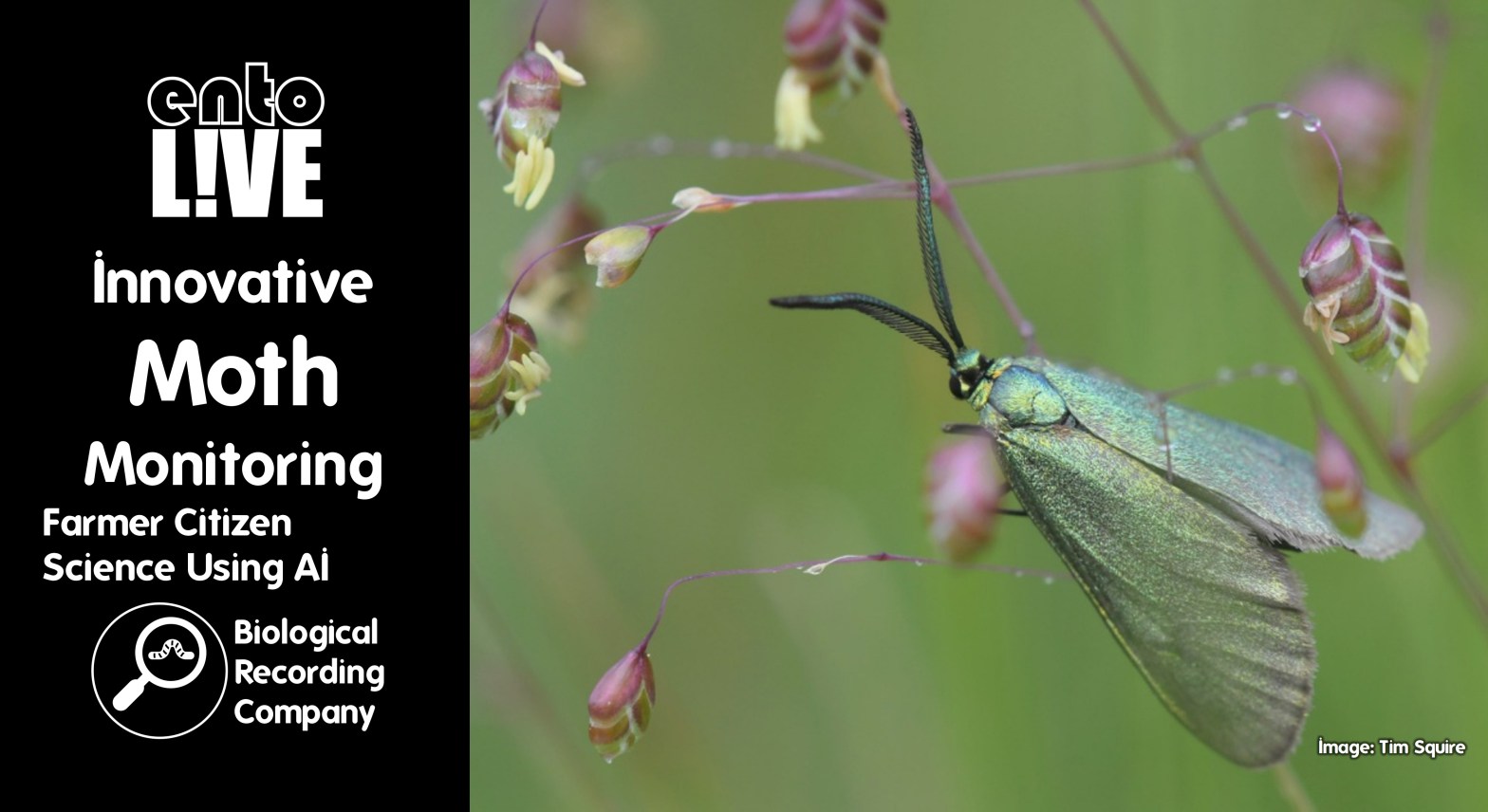
Farmland, covering 67% of England, is crucial in supporting nature recovery, yet good biodiversity data in farmland is often lacking. In this talk, Abigail presents results from a pilot involving 21 farmers across southern England who engaged in moth monitoring on their farms during 2024. Farmers used robust, portable LED light traps to capture moths weekly, and used an innovative AI-based identification app to generate real-time data. She gathered feedback from participants to understand farmer motivations, how this could be supported with effective, personalised feedback, and how the data is influenced by the accuracy of AI-based moth identification.
Q&A with Dr Abigail Lowe
Dr Abigail Lowe is an Interdisciplinary Ecologist at the UK Centre for Ecology & Hydrology. Her research uses citizen science to understand the interaction of people, nature, and environmental data. Abigail’s work focuses on the use of co-design in the development of citizen science projects, ensuring that studies are designed with input from the participants involved.
1. Can you expand more on the AI identification algorithm used? What is it based on?
The image classifier contained in the e-Surveyor app uses the Nature Identification application programming interface (API) created by Naturalis Biodiversity Centre (the same identification algorithm used by the popular nature identification app ObsIdentify). We haven’t yet connected with the Dutch team behind the algorithm about this project specifically, but we are keen to. The pilot enabled us to identify commonly misidentified UK moths, and adding more training photos from specific angles or grouping species that can’t reliably be distinguished could help improve identification accuracy.
2. How did you convince farmers to get involved? Farmers famously don’t have much free time!
We aimed to engage a diverse range of farm types and attitudes towards wildlife-friendly farming, but project timelines and the need to work through an intermediary for recruitment meant we prioritised farmers who were easier to reach for this initial phase, which meant those already involved in wildlife-friendly farm clusters. Before the project, I conducted interviews to identify the reasons these farmers had expressed interest in getting involved and to find out more about how the data collected would be valuable to them. The interviews showed that farmers were primarily motivated by curiosity about the biodiversity on their land. We also carried out questionnaires following the moth monitoring. From that we identified the greatest barrier to participation was a lack of time. Within the pilot and beyond, we are working on how personalised feedback can encourage participation, beyond the intrinsic motivations some farmers already have. One great way to do this is with well-presented, eye-catching and easy-to-understand results summaries within the app. The real test will be to see whether we can successfully engage with farmers who are less intrinsically interested in nature.
3. Did you collect data on the abundance of moths, as well as which species were present?
Yes, we did. We asked farmers to take photographs of every single moth in the trap, so each photograph was treated as a single occurrence and gave a measure of abundance. But, as anyone who has every used a moth trap knows, there is a caveat to this: sometimes (indeed, arguably often) you are not able to get a photograph of every individual moth in a moth trap; some moths may fly away when you open the trap, others you might miss when searching through it. Extra frustratingly, such especially flighty or especially well-camouflaged moths are a non-random sample of UK moth species. In other words, some moths are more likely to be lost or missed than others. That doesn’t necessarily invalidate all the abundance data, but it’s a caveat to bear in mind.
4. Are the moth records generated openly accessible for others to see? I.e. have they shared with databases such as iRecord or the NBN Atlas?
Not yet, but hopefully soon – yes! The County Moth Recorders in the counties where we conducted this pilot study are aware of this project through engagement with Butterfly Conservation (BC) and will be receiving the verified data directly in due course. Furthermore, and more ultimately, we hope to establish a data flow pathway so that this data can transfer through to iRecord where it will be openly available and can go on to UK databases such as the NBN Atlas. However, as AI-generated identifications are relatively new for the verifier community, we are approaching this carefully and engaging with County Moth Recorders via BC to explore their attitudes towards engaging with these data.
5. Did you have any concerns from farmers about finding rare or notable species on their land?
Although a few farmers were initially worried that finding a rare moth on their land might lead to new restrictions or attract crowds of keen recorders, these concerns eased as the project progressed. In reality, moths don’t generate excitement on the same level as rare or migrant birds, especially as they are unpredictable from night to night, and we weren’t sharing records in real time. We were also confident that farmers would not catch any moth species with statutory protections that would affect farm management. With those worries set aside, we actually started observing the opposite phenomenon; farmers started becoming competitive with one another to see whose farm hosted the most exciting moths. One farmer was lucky enough to catch a nationally scarce Scarce Forester (Jordanita globulariae) and was both very proud of the fact and very happy for that information to be shared!
Literature References
- Staley et al. (2024) ‘Evaluating the current state and potential of citizen science involving farmers’: https://publications.naturalengland.org.uk/publication/4635559178534912
- Peter et al. (2019) ‘Participant outcomes of biodiversity citizen science projects: A systematic literature review’: https://doi.org/10.3390/su11102780
- van der Wal et al. (2016) ‘The role of automated feedback in training and retaining biological recorders for citizen science’: https://doi.org/10.1111/cobi.12705
Further Info
- DEFRA Agriculture in the United Kingdom 2022: https://www.gov.uk/government/statistics/agriculture-in-the-united-kingdom-2022
- Farmer-led monitoring in the Netherlands and Ireland:
- Moth trapping: https://butterfly-conservation.org/news-and-blog/how-to-make-your-own-moth-trap
- e-Surveyor: https://esurveyor.ceh.ac.uk/
- Transform Crop Rotation Project: https://www.transform-rotations.eu/
- Engaging farmers in moth monitoring to support biodiversity UKCEH article: https://www.ceh.ac.uk/news-and-media/blogs/chilterns-pembrokeshire-ukceh-growing-farmer-led-moth-monitoring-support
- Plants for Pollinators: Using DNA to Explore Relationships in Gardens (entoLIVE): https://biologicalrecording.co.uk/2024/12/03/plants-for-pollinators/
- Nature Overheard: Acoustic Monitoring for Insects Through Community Science (entoLIVE): https://biologicalrecording.co.uk/2024/03/18/nature-overheard/
entoLIVE
entoLIVE webinars feature guest invertebrate researchers delving into their own invertebrate research. All events are free to attend and are suitable for adults of all abilities – a passion for invertebrates is all that’s required!
- Donate to entoLIVE: https://www.gofundme.com/f/entolive-2025
- Upcoming entoLIVE webinars: https://www.eventbrite.com/cc/entolive-webinars-74679
- entoLIVE blog: https://biologicalrecording.co.uk/category/entolive-blog/
- entoLIVE on YouTube: https://youtube.com/playlist?list=PLuEBNUcfMmE95Re19nMKQ3iX8ZFRFgUAg&feature=shared
entoLIVE is delivered by the Biological Recording Company in partnership with the British Entomological & Natural History Society, Royal Entomological Society and Amateur Entomologists’ Society, with support from Buglife, Field Studies Council and National Biodiversity Network Trust.
The entoLIVE programme is delivered by Biological Recording Company and receives sponsorship from the following organisations:
- British Entomological & Natural History Society
- Royal Entomological Society
- Amateur Entomogists’ Society
Learn more about British wildlife

 Biological Recording