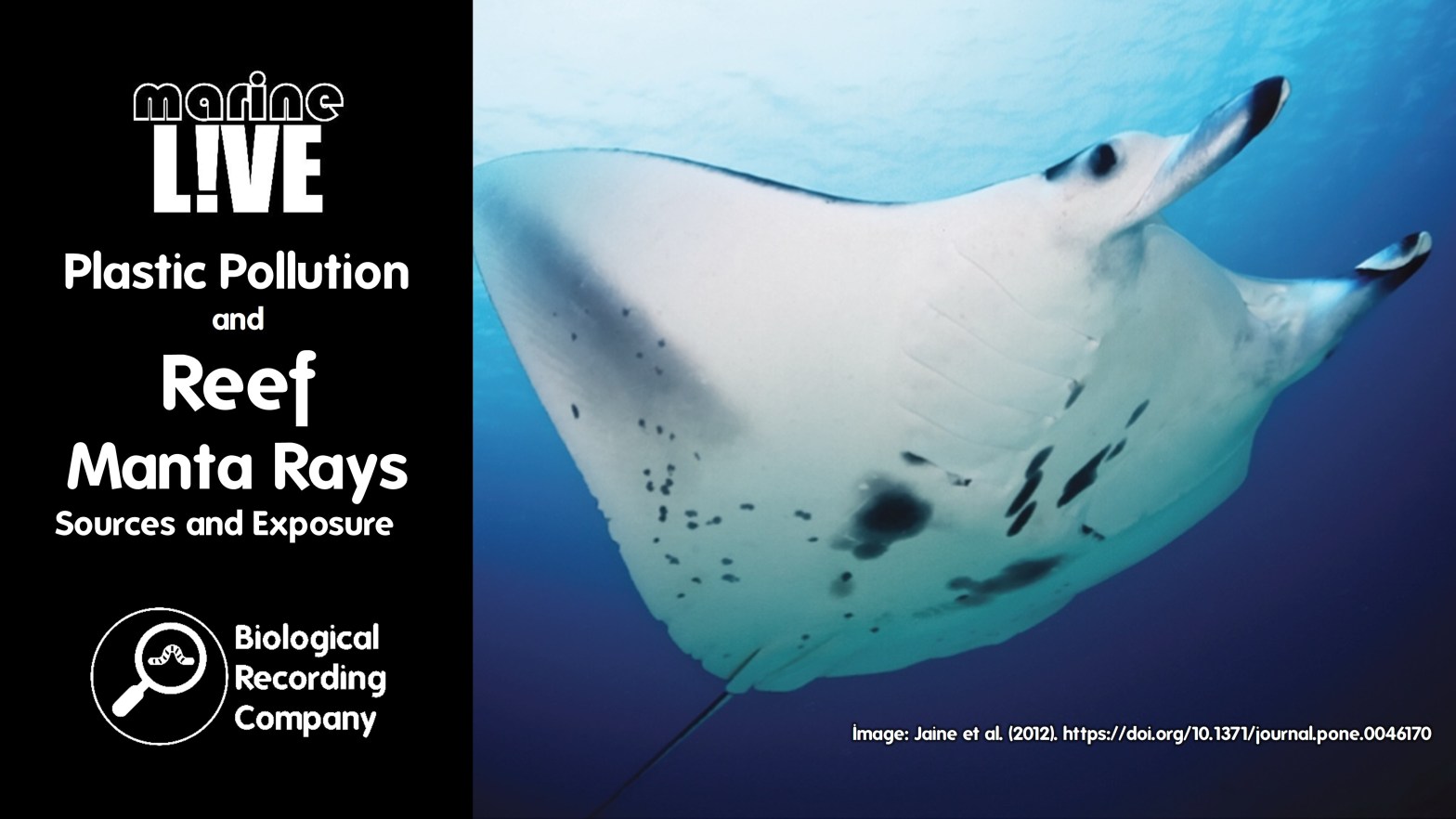
Plastic pollution is ubiquitous and increasing in the marine environment, particularly in remote locations. The effects on marine life include entanglement, ingestion, and potential leaching of toxic plastic additives into tissues. A study investigated the exposure of reef manta rays to plastic pollution in a remote archipelago in the Indian Ocean, including abandoned, lost or discarded fishing gear, and microplastics. Additionally, it examined the origins of plastic drink bottles on the beaches of the Chagos Archipelago to understand the origins of the debris, and make Extended Producer Responsibility recommendations in the Global Plastics Treaty currently being negotiated by the United Nations.
Q&A with Dr Jessica Savage
Dr Jessica Savage is a recent PhD graduate from the London NERC Doctoral Training Programme, based at Royal Holloway University of London and the Institute of Zoology (Zoological Society of London). Her research interests include the exposure of species to plastic pollution using suitable habitat modelling, empirical plastic sampling, and brand audits of debris to understand their origins. She also enjoys science communication and public engagement with audiences ranging from school students to policymakers.
1. You mentioned that the main microplastic fibres you collected were black and blue. What is the significance of this? Does it tell us anything about the source of the pollution?
Microplastics are notoriously difficult to apportion sources to. It’s effectively complex detective work, and we can never say for sure where a given fibre has come from. That caveat aside, the black and blue fibres generally point towards clothes washing as a source. These fibres enter the ocean from domestic washing machine wastewater outputs via rivers. Blue fibres have also recently been shown to be linked to fishing activity, specifically the fraying of plastic ropes and other similar equipment.
2. Are there any initiatives conducting analyses of dead manta rays to identify the plastic pollution in their tissues?
I considered doing this as part of my PhD research, but unfortunately it’s quite logistically difficult. For a start, Reef Manta Rays are a protected species (their status has recently been upgraded on CITES, actually), so it’s very difficult to get permission to do analysis looking at tissue or stomach content analysis. You would probably need to rely on bycatch from fishing vessels, or potentially opportunistic sampling of dead, washed-up rays. I know there’s been similar research on plastic contamination in tissues of deceased beached Whale Sharks, for example. But it’s very difficult to get access to carcasses, not to mention the fact that they rarely wash up in the first place. Some alternative options are to study microplastic pollution in egested materials (vomit and faeces) or to do biopsies (studying samples of tissue from live animals). These methods have been used to study plastic contamination in other elasmobranchs (e.g. Whale Sharks) but haven’t yet been applied to Reef Manta Rays.
3. Are Reef Manta Rays threatened by swallowing macroplastics (e.g. plastic bags, flip flops, plastic water bottles)?
In theory, they could be, yes. The way Reef Manta Rays feed is by opening their mouths and hoovering up plankton as they swim through the ocean. If there was a piece of plastic in the water column, it could definitely end up being swallowed and blocking the ray’s digestive tract. However, I don’t think this has been observed happening so far. It has definitely been observed in Whale Sharks though, so it’s possible it could affect rays.
4. You mentioned in the talk that much of the plastic pollution in the ocean comes from ships, rather than land. Is anything being done to regulate how ships use and dispose of plastic waste?
There is an international law called MARPOL Annex V which criminalises the disposal of plastic waste at sea. Unfortunately, it is not always adhered to, as my research makes clear. What’s particularly interesting to me is that sometimes we find plastic waste that has clearly been through a ship’s waste processing facility (e.g. plastic bottles that are compressed and condensed) but which has nevertheless ended up in the ocean! The behaviour and motivations behind the disposal of waste at sea has been studied by a few researchers. One key driving factor identified is the fact that ships usually have to pay to dispose of their waste at ports, hence companies may instead choose to dispose of the waste at sea where nobody will see them do it. Out of sight out of mind, so to speak. I believe what is needed to counteract this is to establish incentives for shipping companies to retain their waste until they reach appropriate disposal facilities on land. There are people working on this currently.
5. What role does tourism play in driving plastic pollution in the Indian Ocean?
This is a really important point, and the reason why I mentioned in the talk (and also in my paper) that there is more nuance to the question of attributing ‘blame’ than simply pointing the finger at certain countries. Tourism is a huge part of the problem of plastic pollution in the Indian Ocean. This is particularly true in places like the Maldives where the economy relies almost wholly on tourism. Another factor which is important to bear in mind is waste trade. The Global North exports much of its waste to the developing world, particularly to countries in Southeast Asia. Historically China was the global waste processing hub, but recently they have has halted all waste import. In its place, other countries, particularly Malaysia and Indonesia, have taken up the mantle. These countries do not necessarily have the facilities required to properly handle all this plastic waste, and some is clearly leaching into the environment. This represents another source. We have to be very careful when apportioning the blame for the global plastic pollution problem.
6. What advice would you give to people living in the UK/Europe to help reduce marine plastic pollution?
In your own life, within the boundaries of your own means and time and capabilities, try and move away from single-use plastic. Where possible, start buying second hand items, particularly clothes. If you live on the coast, find a local beach-cleaning group and help out, even if it’s just once a month. In your local area, write to your local politicians and raise how important of an issue you think it is that the UK has a strong position on the Global Plastics Treaty. Get involved in any local activism you can!
Literature References
- Strike et al. (2022) ‘Sublethal Injuries and Physical Abnormalities in Maldives Manta Rays, Mobula alfredi and Mobula birostris’: https://www.frontiersin.org/journals/marine-science/articles/10.3389/fmars.2022.773897/full
- Savage et al. (2025) ‘No escape from microplastics: Contamination of reef manta ray feeding areas in a remote, protected archipelago’: https://conbio.onlinelibrary.wiley.com/doi/10.1111/csp2.70059
- Savage et al. (2024) ‘Big brands impact small islands: Sources of plastic pollution in a remote and protected archipelago’: https://www.sciencedirect.com/science/article/abs/pii/S0025326X24004533?via%3Dihub
- Hays et al. (2020) ‘A review of a decade of lessons from one of the world’s largest MPAs: conservation gains and key challenges’: https://link.springer.com/article/10.1007/s00227-020-03776-w
- Thompson et al. (2024) ‘Twenty years of microplastic pollution research—what have we learned?’: https://www.science.org/doi/10.1126/science.adl2746
- Harris et al. (2024) ‘Spatiotemporal variations in reef manta ray (Mobula alfredi) residency at a remote meso-scale habitat and its importance in future spatial planning’: https://onlinelibrary.wiley.com/doi/10.1002/aqc.4089
- Duncan et al. (2020) ‘Message in a bottle: Open source technology to track the movement of plastic pollution’: https://journals.plos.org/plosone/article?id=10.1371/journal.pone.0242459&utm_keyword=referral_inverse
Further Info
- Manta Trust: https://www.mantatrust.org/
- Mobula alfredi – IUCN Red List: https://www.iucnredlist.org/species/pdf/214395983
- Plastic Adrift: https://plasticadrift.org/
- Global Plastics Treaty: https://www.globalplasticaction.org/globalplasticstreaty
- Mobulid Rays in the Chagos Archipelago: Fisheries & Conservation Management marineLIVE blog: https://biologicalrecording.co.uk/2025/04/29/devil-and-manta-rays/
- Microplastic Pollution and Solutions marineLIVE blog: https://biologicalrecording.co.uk/2025/02/25/microplastics/
- Petition – Sainsbury’s & Tesco: publicly support real action to cut plastic production: https://you.38degrees.org.uk/petitions/sainsbury-s-and-tesco-must-publicly-support-a-cut-in-plastic-production
marineLIVE
marineLIVE webinars feature guest marine biologists talking about their research into the various organisms that inhabit our seas and oceans, and the threats that they face. All events are free to attend and are suitable for adults of all abilities – a passion for marine life is all that’s required!
- Upcoming marineLIVE webinars: https://www.eventbrite.co.uk/cc/marinelive-webinars-3182319
- Donate to marineLIVE: https://gofund.me/fe084e0f
- marineLIVE blog: https://biologicalrecording.co.uk/category/marinelive-blog/
- marineLIVE on YouTube: https://youtube.com/playlist?list=PLuEBNUcfMmE-t2dzcoX59iR41WnEf21fg&feature=shared
marineLIVE is delivered by the Biological Recording Company with funding from the British Ecological Society.
- Explore upcoming events and training opportunities from the Biological Recording Company: https://www.eventbrite.co.uk/o/the-biological-recording-company-35982868173
- Check out the British Ecological Society website for more information on membership, events, publications and special interest groups: https://www.britishecologicalsociety.org/
Learn more about British wildlife



 Biological Recording