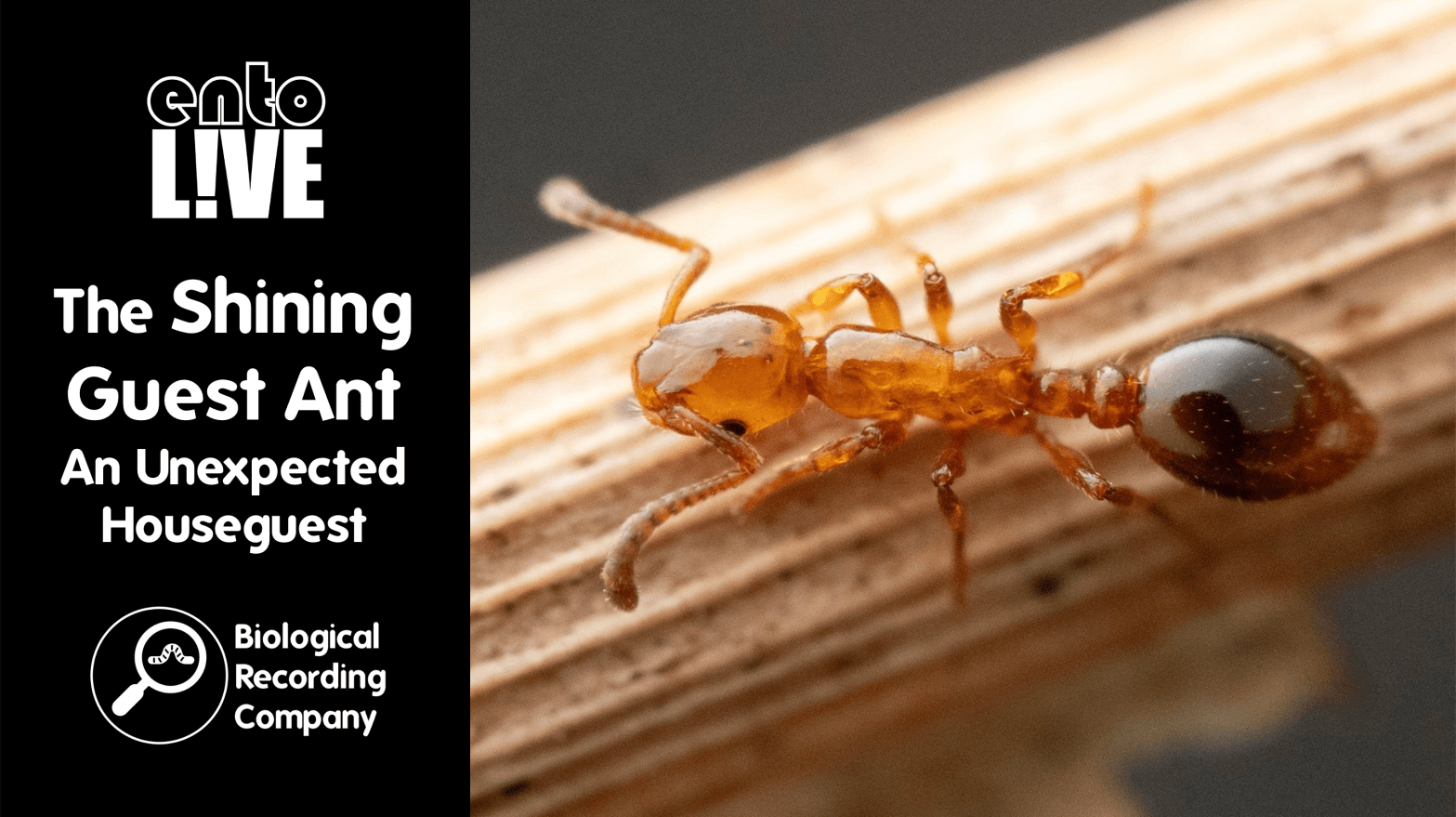
The Shining Guest Ant (Formicoxenus nitidulus) is a tiny and elusive ant that lives as an uninvited but harmless ‘guest’ in the nests of much larger Wood Ants (Formica rufa group). For a new Shining Guest Ant queen, establishing a colony is a challenging task. To avoid the inbreeding risk of saying local, she must disperse and not only find the right woodland habitat, but also locate a suitable new host nest. Because of their secretive nature and small size, these ants are underrecorded and their movements are poorly understood. In this talk, Elva shares new, surprising research about Shining Guest Ant queens’ ability to find new homes, and will provide tips on how to spot these elusive creatures on your next walk in the woods.
Q&A with Professor Elva Robinson
Elva Robinson is a Professor in Ecology at the University of York. She studies the organisation of social animal groups using ants as her model system, and is especially interested in the interactions between social behaviour and environmental change.
1. Why do Shining Guest Ants only live in Wood Ant nests?
Wood Ants bring in a huge amount of food from the surrounding environment into their nests, to the extent that each nest acts as a sort of ‘nutrient hotspot’ in the landscape. Many other species have evolved to take advantage of this high-density food hotspot through eating the ‘scraps’ left behind by the Wood Ants. The Shining Guest Ant is one such example, and there are many others. Wood Ants are unique in their ability to provide this sort of environment; it is unparalleled even by other nest-building ants (e.g. Yellow Meadow Ants). In addition to food, Wood Ant nests also provide the Shining Guest Ant colony with suitable nesting conditions. The nests are made of a ‘thatch’ of fragmented leaf litter, which contains hollow twigs and grass stems which are required for the Shining Guest Ant colony, and provide a level of physical protection absent elsewhere in the landscape.
2. What percentage of Wood Ant nests contain Shining Guest Ant colonies?
It’s certainly not all of them! Beyond that, though, the answer seems to vary considerably between locations. In one of my study sites in the North York Moors, I found that over 80% of Wood Ant nests contained Shining Guest Ant colonies. At a different study site in Derbyshire, fewer than 10% of nests have Shining Guest Ants within them. It would be fascinating to understand why Shining Guest Ants are so prevalent at some sites but not others. For now, we have very little idea! More research is needed – and you can help! If you want to record wood ant nests and their guests, you can contribute to our Europe-wide Citizen Science project – MonitAnt.
3. You explained in the talk that one Wood Ant nest can support multiple Shining Guest Ant colonies. We also know that many ant species are highly territorial and aggressive. Is there ever any aggression between Shining Guest Ant colonies within a shared Wood Ant nest?
I’ve never observed inter-colony aggression, personally, but I would expect that there would be some. The most closely related species to Shining Guest Ants we have in the UK are ants in the genera Temnothorax and Leptothorax. Species in those genera are known to be highly aggressive towards workers from other colonies – often fighting each other to the death. I therefore think it’s likely that Shining Guest Ant colonies also fight each another. On the other hand, a Wood Ant nest is very big compared to the size of a Shining Guest Ant colony. Considering each Wood Ant nest might, at most, only contain a handful of Shining Guest Ant colonies, they can probably avoid each other for the most part by having their own territorial ‘patches’. Perhaps unsurprisingly, it’s really hard to study what happens inside a Wood Ant nest, so again we aren’t yet sure of what exactly goes on!
4. Do Shining Guest Ants have a preference for certain plant materials for nesting?
My personal experience suggests they are quite flexible. Even at sites where the occupancy rate of Shining Guest Ants within Wood Ant nests is low, there is considerable variation between Wood Ant nests in terms of the thatch material used by Shining Guest Ants for nesting. I am personally yet to see a strong relationship between occupancy and plant material available. Yet again, though, we do not really have strong enough data to make a confident statement here. More research needed!
5. Does anything eat, predate or parasitise Shining Guest Ants?
This is another really interesting question, and yet again, I have to answer that we do not really know! One particular area of interest would be fungal parasites. We know there are several species of pathogenic fungi specialised on Wood Ants. It would be fascinating to see whether Shining Guest Ants also carry these. In the eventuality that Shining Guest Ants somehow do not pick the pathogens up from the Wood Ants, I’d love to know what exactly they’re doing to prevent this transmission!
Literature References
- Robinson et al. (2025) ‘Insights into the population genetics of an extreme habitat specialist, the wood ant commensal Formicoxenus nitidulus’: https://pure.york.ac.uk/portal/en/publications/insights-into-the-population-genetics-of-an-extreme-habitat-speci/
- Martin et al. (2007) ‘Chemical deterrent enables a socially parasitic ant to invade multiple hosts’: https://pmc.ncbi.nlm.nih.gov/articles/PMC2279212/pdf/rspb20070795.pdf
Further Info
- Bees, Wasps and Ants Recording Society: https://bwars.com/
- MonitAnt Website: https://www.monitant.de/
- MonitAnt Citizen Science project: https://www.monitant.de/how-to-participate/
entoLIVE
entoLIVE webinars feature guest invertebrate researchers delving into their own invertebrate research. All events are free to attend and are suitable for adults of all abilities – a passion for invertebrates is all that’s required!
- Donate to entoLIVE: https://www.gofundme.com/f/entolive-2025
- Upcoming entoLIVE webinars: https://www.eventbrite.com/cc/entolive-webinars-74679
- entoLIVE blog: https://biologicalrecording.co.uk/category/entolive-blog/
- entoLIVE on YouTube: https://youtube.com/playlist?list=PLuEBNUcfMmE95Re19nMKQ3iX8ZFRFgUAg&feature=shared
entoLIVE is delivered by the Biological Recording Company in partnership with the British Entomological & Natural History Society, Royal Entomological Society and Amateur Entomologists’ Society, with support from Buglife, Field Studies Council and National Biodiversity Network Trust.
The entoLIVE programme is delivered by Biological Recording Company and receives sponsorship from the following organisations:
- British Entomological & Natural History Society
- Royal Entomological Society
- Amateur Entomogists’ Society
Learn more about British wildlife
 Biological Recording
One thought on “The Shining Guest Ant: An Unexpected Houseguest”