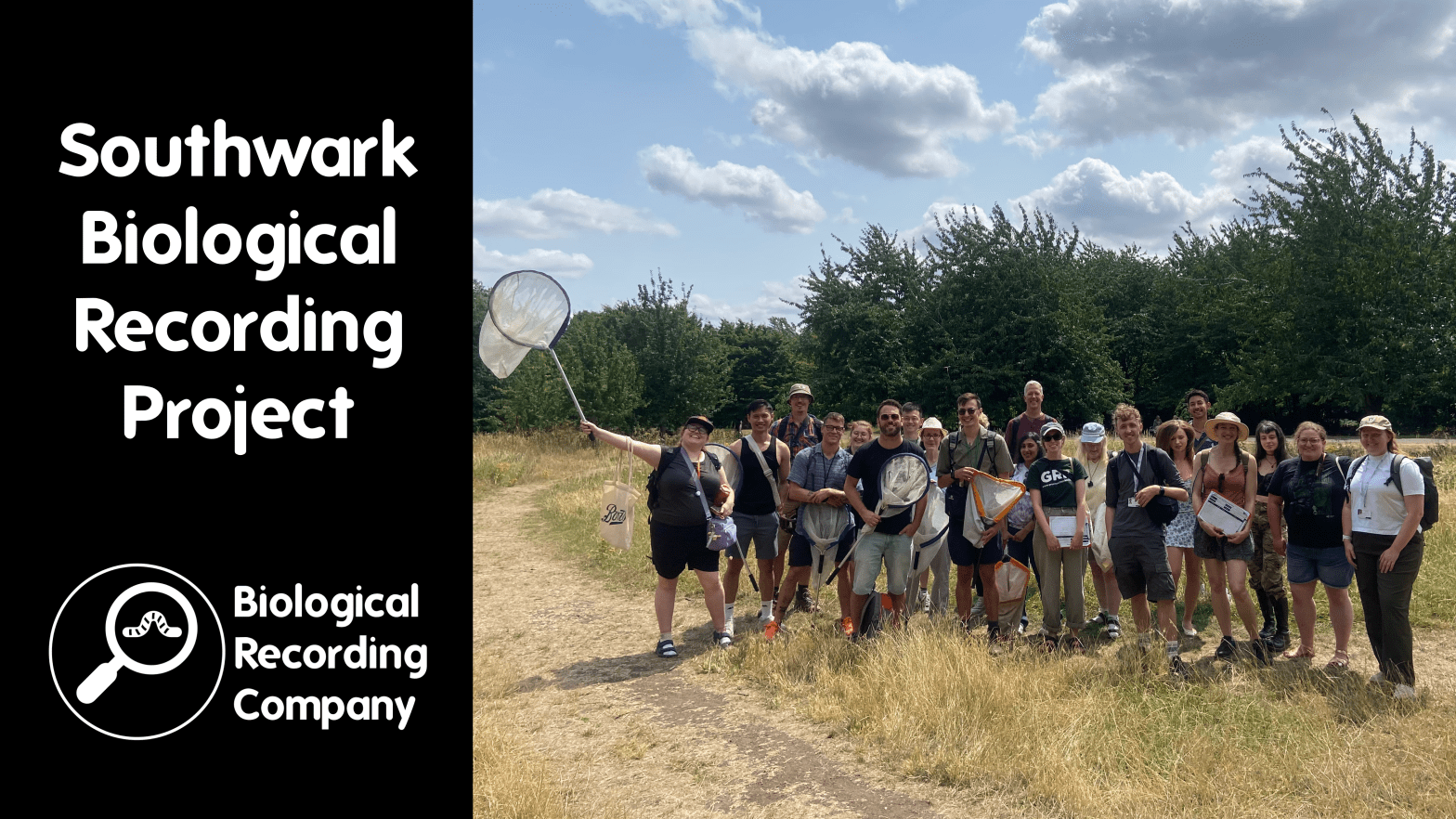
The Biological Recording Company was commissioned in April 2025 by Southwark Council to deliver a programme of five courses and events in 2025 as part of a wider programme of free-to-attend biodiversity learning opportunities within the London Borough of Southwark. Of the five events we organised, two were training courses and three were outdoor recording events: two Field Recorder Days, one focused on beetles and another on botany, and one Earthworm Sampling Day. This blog shares highlights from this project, with a full report at the bottom of the blog.
🐝 Training Courses
Two one-day biological recording training courses were delivered at sites within the London Borough of Southwark, with subjects aimed at those new to biological recording and an emphasis on developing biological recording skills in Southwark residents. A total of 48 learner days were completed across the two training courses.
Biological Recording 101 took place at the Centre for Wildlife Gardening on 3 June 2025, taught by Keiron Brown with 31 participants. The course highlighted the value of biological recording for understanding and protecting wildlife. Attendees learned to collect and submit species data via iRecord and manage records to support local biodiversity monitoring.
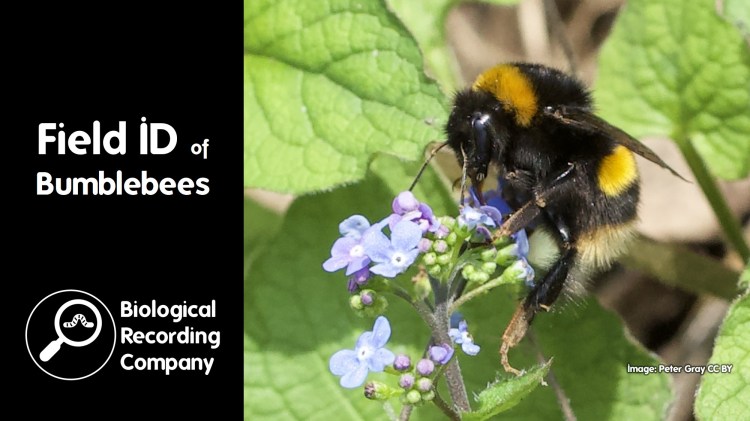
Field ID of Bumblebees took place at The Paper Garden on 9 August 2025, taught by Mark Patterson with 22 attendees. The course covered classroom and field ID of the UK’s “Big 8” species. Participants learned taxonomy, key features, and ID resources, practiced collecting and recording bumblebees via iRecord, and gained skills for planning and running BeeWalk surveys.
🪲 Beetle Field Recorder Day
When: 14th July 2025 | Where: Burgess Park
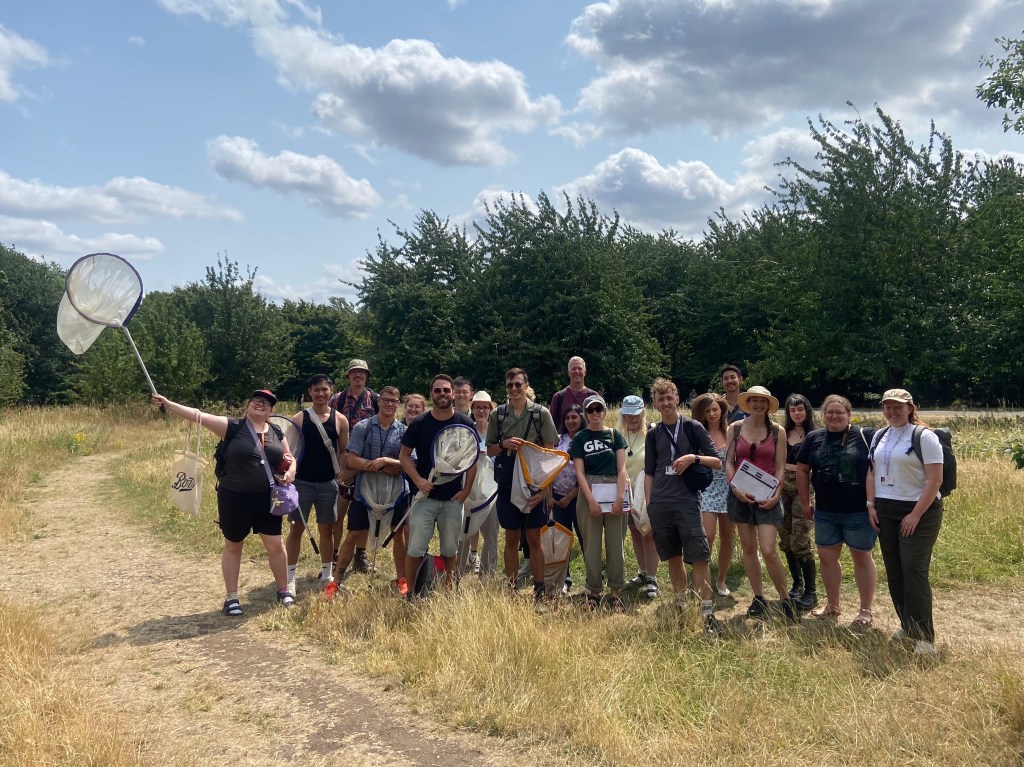
On the 14th of July we held a Beetle Field Recorder Day in Burgess Park. We had a great turnout: a party thirty beetle enthusiasts strong, with everyone from total newcomers to ardent coleoptera fanatics represented. With beetle specialist Connor Butler heading the team, we worked a way through the varied habitats of this Southwark green space gem over the course of a lovely summer’s day, visiting wildflower meadows, ornamental gardens, urban woodland areas and the margins of the large lake in the park. In total we generated 384 new species occurrence records for the park, including 121 records of 39 different beetle species.
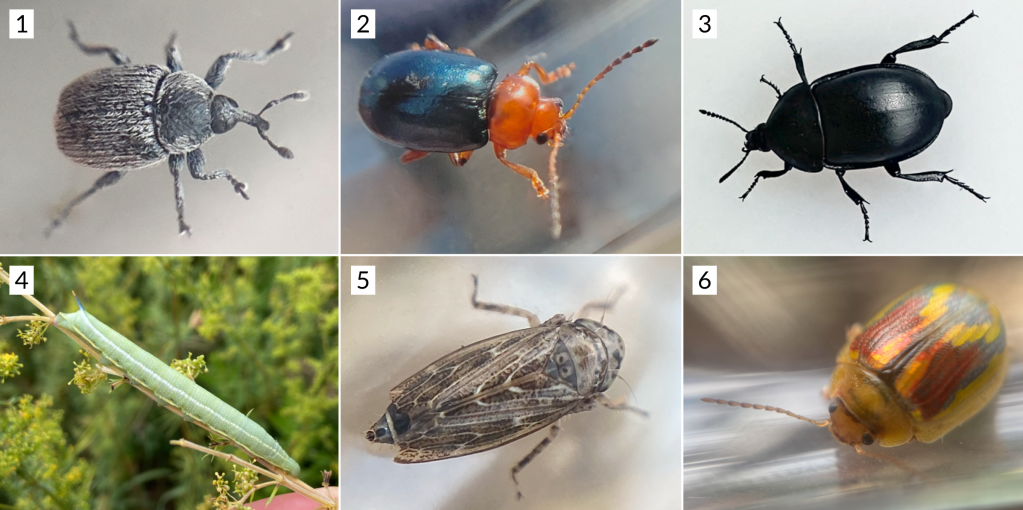
Six highlights from our Beetle Field Recorder Day are shown above.
- The weevil Rhinusa neta (Curculionidae) was found on Common Toadflax Linaria vulgaris. This species is a fairly recent arrival, first noticed in the UK in 2019 with re-examined specimens dating back to 2013. The species is currently localised to the Greater London area.
- The colourful leaf beetle Podagrica fuscicornis (Chrysomelidae) was found on Malva sylvestris, its main host plant.
- Ablattaria laevigata (Silphidae), a large black beetle which uses its long head to suck snails out of their shells, was found under deadwood.
- Two chunky green Eurasian Hummingbird Hawkmoth (Macroglossum stellatarum) caterpillars were found feeding on a large patch of Lady’s Bedstraw (Galium verum) in a gardened section of the park.
- The Nationally Scarce (Notable B) leafhopper Euscelidius variegatus, was swept from an area of rough dry grassland.
- The gorgeous Paropsisterna selmani (Chrysomelidae) was found near Glengall Wharf Garden. This large non-native beetle is originally from Australia, having arrived in the UK in 2007. It feeds exclusively on Eucalyptus and so has been flagged as a potential pest to arboriculture.
🌿 Botany Field Recorder Day
When: 24th September 2025 | Where: Belair Park & Dulwich Park
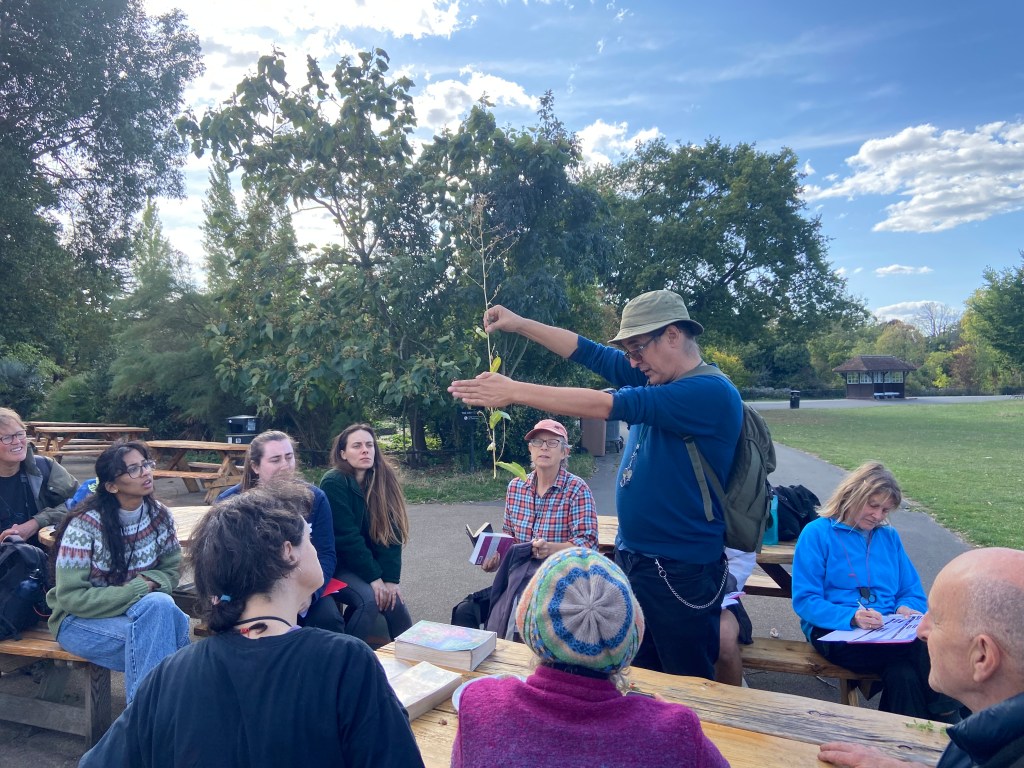
On 24th September we were back in Southwark, this time in the south of the borough, with botany as our focus and Dr Mark Spencer leading the event. Botany proved to be even more popular than beetles – a record-breaking 38 attendees showed up ready to record the flora of Belair Park and Dulwich Park. With a record-breaking number of attendees and a huge variety of plant species across the two parks, it was unsurprising that we also smashed our previous records for total number of biological records generated: 577 records, including 477 records of 154 different plant species. That’s a good 200 more records than our previous high score: a seriously sterling effort from everyone involved.
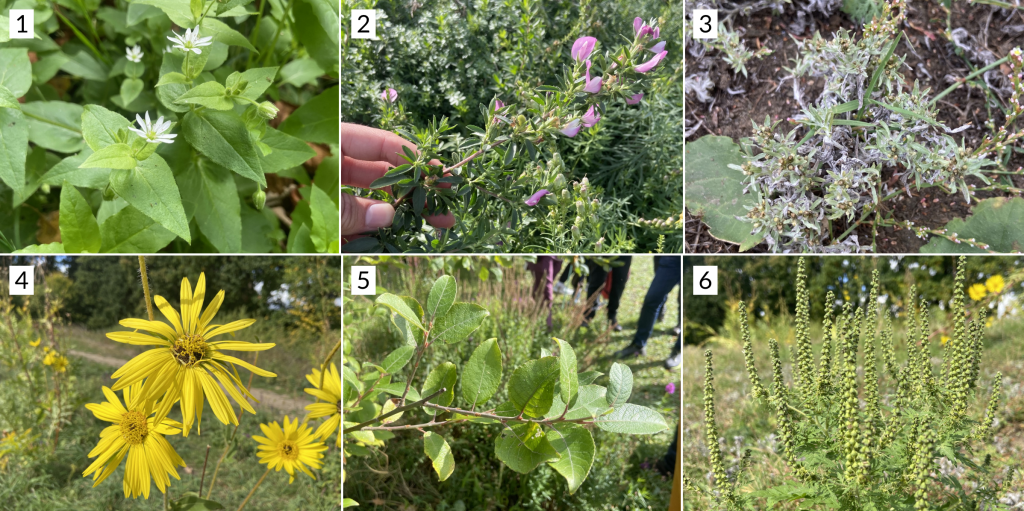
Six highlights from our Botany Field Recorder Day are shown above:
- A large patch of the uncommonly encountered Stellaria aquatica (Water Chickweed) was found in a damp area near the lake in Belair Park.
- Ononis × pseudohircina, the hybrid between Ononis repens and Ononis spinosa was found in a dry, disturbed area in Dulwich Park.
- Gnaphalium uliginosum (Marsh Cudweed) was abundant in the dried-out reservoir in the north-west corner of Belair Park was, among several other unusual plants typical of ‘draw-down’ zones (a scarce habitat in Greater London).
- The non-native North American Silphium laciniatum (Compass Plant) was proliferating alarmingly in both the dried-reservoir in Belair Park and a disturbed area in Dulwich Park. It has been flagged to site managers as warranting removal.
- The hybrid willow Salix × capreola (S. aurita × S. caprea) was among several hybrid willows in the dried-out reservoir in Belair Park.
- Ambrosia artemisifolia, another non-native species from North America, was another surprising find in Belair Park. This species is wind-pollinated and, where the plant is abundant, its pollen is a major contributor to hay fever.
🪱 Earthworm Sampling Day
When: 1st October 2025 | Where: Galleywall Nature Reserve & Rouel Road Estate Community Orchard
A group of 15 volunteers joined Keiron Derek Brown on 1st October to conduct earthworm sampling at two small locally managed sites in the north-east of Southwark: Galleywall Nature Reserve and Rouel Road Estate Community Orchard. Earthworms were collected at both sites through a range of soil pit sampling, vermifuge extraction and microhabitat searches. Specimens were collected into ethanol and identified using a microscope at a later date. As a result of the day’s efforts, 55 new species occurrence records were generated, of which 31 were earthworm records representing 11 different earthworm species.
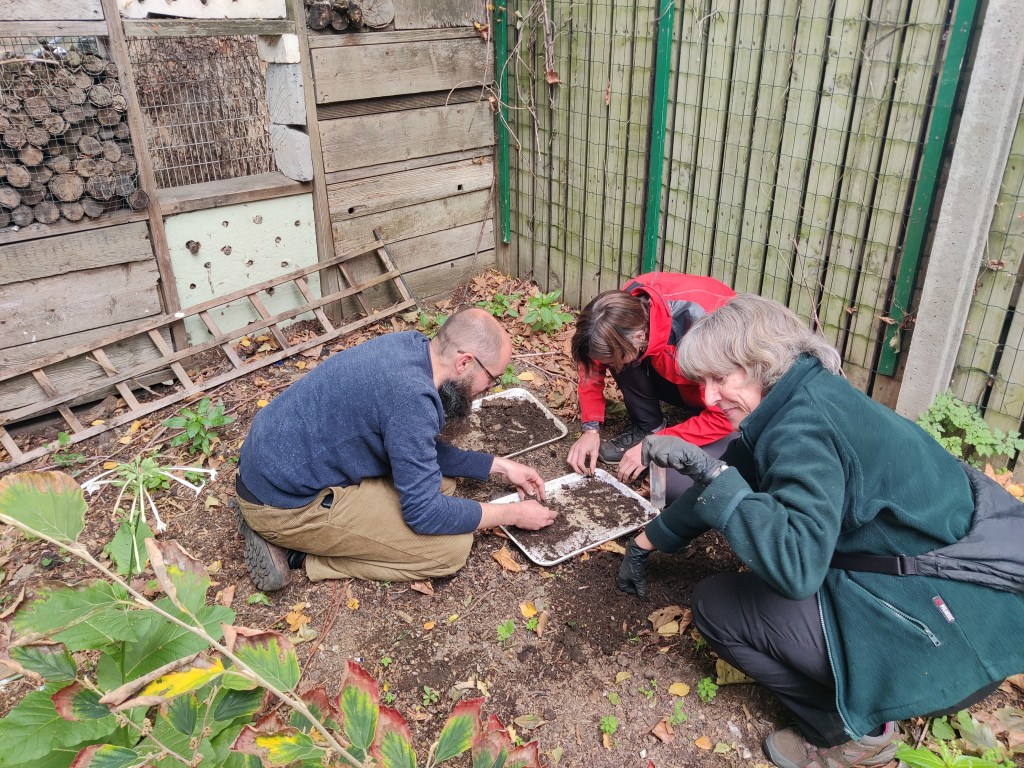
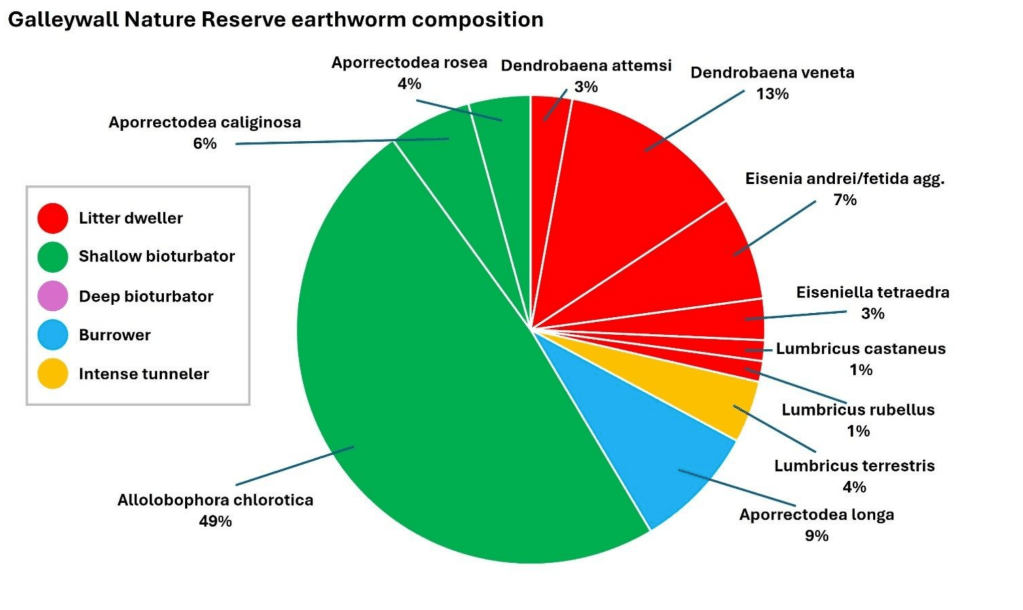
Galleywall Nature Reserve had a high diversity of species, with four functional groups of earthworms represented. The use of manure to enrich the soil appears to have increased the proportion of litter dweller species present (e.g. Eisenia andrei/fetida agg and Dendrobaena veneta). The absence of deep bioturbators found could be a result of the disturbance from recent conservation works or due to the recent dry weather.
Rouel Road Estate Community Orchard, in contrast, yielded very few earthworms during the survey. Only two of the functional groups were represented (shallow bioturbators and burrowers) and only three species were found. It is likely that the earthworm population will improve with wetter weather (it was a very dry summer/early autumn) and as the orchard matures. The addition of deadwood resources has also been suggested to site managers.
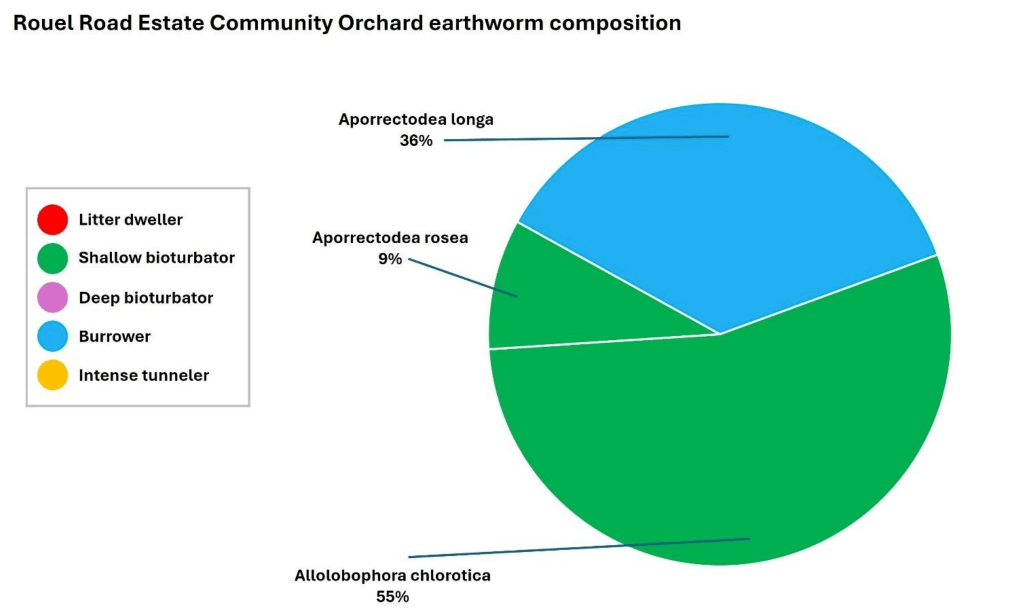
Estate Community Orchard. Pie chart slice colours indicate the functional group of the represented species (c) Biological Recording Company
Project Achievements
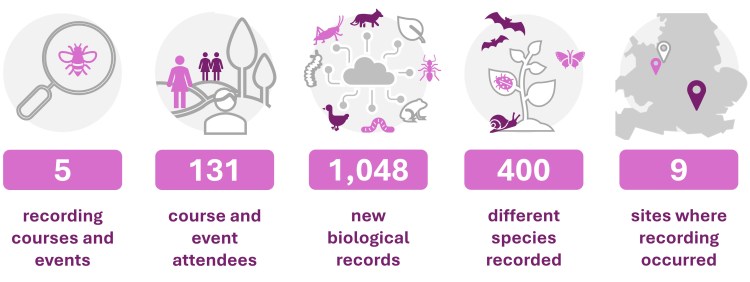
Across the three events summarised above, 83 people were engaged in biological recording, 1,048 new biological records were generated and 400 different species were recorded. The vast majority of the species found represent first records for the respective sites. All records contribute towards building a picture of the biodiversity present in Southwark and will inform future conservation management work. As always, our data is gathered through iRecord so it is automatically accessible to Greenspace Information for Greater London (GiGL) and the relevant National Recording Schemes & Societies.
You can read the full report covering all of our recording activities and achievements in Southwark below:
A huge thank you to everyone who joined us at our events in Southwark this summer and autumn. It was great to see so many people – both Southwark residents and enthusiasts from further afield – enjoying green spaces and recording wildlife in green spaces in this lovely London borough. A big thanks also to Liam Nash (Southwark Biodiversity Officer) for commissioning these events and being generally awesome, and to our specialists Mark Spencer, Connor Butler and Keiron Brown for their knowledge and guidance. Finally, thank you to the London Natural History Society for helping to promote the events. We hope to see everyone at future Biological Recording Company events!
This series of events were delivered by the Biological Recording Company in partnership with Southwark Council and the London Natural History Society (LNHS).

Biological Recording Projects
At the Biological Recording Company, we specialise in planning and delivering projects centred around recording wildlife and training naturalists.
- London Recording Projects involve the delivery of events from our Field Recorder Day, Invertebrate Study Day, Earthworm Sampling Day and Training Course programmes. Examples include:
- Site-based projects, such as Wild Tolworth, Ealing Beaver Project and Lesnes 500.
- Borough-based projects, such as our Southwark and Barnet projects.
- Earthworm Projects range from identification training and earthworm surveys to research and consultation. Example include:
- Engagement-focused projects, such as delivering earthworm recorder training in Northern Ireland and working with farmers in the Chilterns.
- Research-focused projects, such as looking at the impact of hay meadow restoration on earthworm communities, assessing the effectiveness of regenerative farming practices and investigating the use of AI in earthworm identification.
- National Biological Recording Projects entail putting our expertise to use with helping other organisations improve the biological recording processes and reach new audiences.
- Training projects include developing online training for Lepidoptera verifiers and producing guidance on the use of Record Cleaner and iRecord.
- Consultation projects include reviewing the pay of natural history tutors and working with the British Mycological Society to improve fungus record quality and data flow.
 Biological Recording