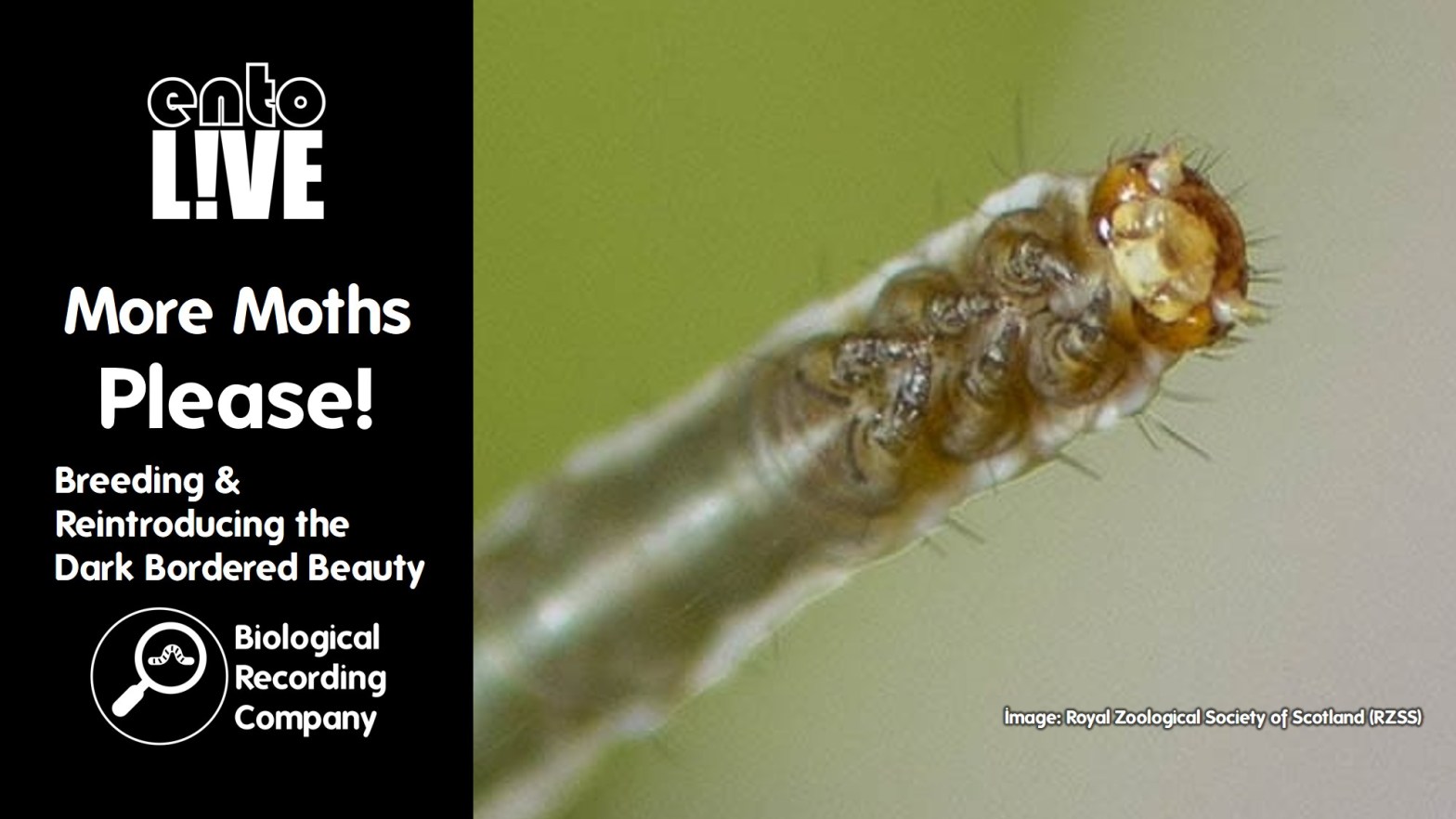
The Dark Bordered Beauty (Epione vespertaria) is a striking moth that, within the UK, is currently restricted to just three sites; two in Scotland and one in York. To help restore this species and safeguard it for the future, RZSS, in partnership with the Rare Invertebrates in the Cairngorms Project, is running a conservation breeding programme providing hundreds of eggs, caterpillars, and moths for release into new sites in the Cairngorms National Park. Helen will give more information on this remarkably rare species, provide the latest news on how the conservation programme is progressing, and detail some of the challenges faced by her team in trying to breed a moth species that is so rarely seen in the wild
Q&A with Georgina Lindsay
Georgina Lindsay is a conservation manager at the Royal Zoological Society of Scotland (RZSS). She manages all of RZSS’ native invertebrate breeding and reintroduction programmes, including dark bordered beauty moths, pine hoverflies, medicinal leeches, and pond mud snails, as well as the field surveys for species such as blood red longhorn beetles and small scabious mining bees. She also oversees the Biodiversity Action Plan for Highland Wildlife Park, including areas such as forestry management and wading bird nest monitoring.
1. Do Dark-bordered Beauty Moth larvae only feed on Aspen? How do we know?
We know that Dark-bordered Beauty Moth larvae feed on Aspen (Populus tremula) at the two Scotland sites because they are almost exclusively found on this host plant there. At the one site in England, in Yorkshire, Creeping Willow (Salix repens) appears to be an alternative known host plant for the larvae. All our conservation breeding work in Scotland has so far used Aspen but we are interested to potentially trial feeding of Scottish larvae on Creeping Willow in the future.
2. How big of a stand of Aspen is needed to support a Dark-bordered Beauty Moth population?
The short answer is we don’t know. Aspen stands size varies between all the sites we work on – both founder sites and release sites. At the Strensall site in Yorkshire, there is no Aspen, and they rely on Creeping Willow, which is an alternative larval food plant here. In the conservation breeding programme, we’re finding that the caterpillars only need a relatively small amount of Aspen to grow to maturity. At our facility we’ve found that 20 caterpillars can be easily supported by six small suckering Aspen trees. This suggest that it’s not the quantity of food per se which is the limiting factor behind their scarce distribution, but instead that disconnected aspen stands are limiting natural dispersal and the colonisation of new sites.
3. Do Dark-bordered Beauty Moth larva only pupate in moss?
In our conservation breeding programme for the Dark-bordered Beauty Moth, we used a bed of Sphagnum moss to provide an area for the caterpillars to pupate. The choice to do this was informed by using similar substrate to that found at the Strathspey founder site. That being the case, it is certainly possible that the moth can pupate on or in other substrates. We have noticed in some of our enclosures that the larvae have successfully pupated on bare ground. It’s also possible that they can pupate within soil, however we have not trialled this due to foreseen difficulties with re-locating pupae within the soil (given they might burrow down into it).
4. Is there a pheromone lure for Dark-bordered Beauty Moths?
Not at the moment. The process of creating a pheromone lure can be quite complex; for example, you need to collect a lot of adult individuals. It’s not something we have spoken much about yet in the context of the Dark-bordered Beauty Moth because so far we have had success with locating adults at known sites using standard light-trapping techniques and transects. Pheromone luring could potentially be a possibility down the line though.
5. Is research into the ecology of this species ongoing?
Whilst my personal focus is on the conservation breeding and reintroduction programme, as a team and steering group focused on conserving the Dark-bordered Beauty Moth we are very keen to find out everything there is to know about the ecology of this moth. Interesting potential ecological research questions are often brought up in steering group meetings. For example, nearly all the current knowledge of feeding preferences is based on observation of the larvae ex situ in the breeding facility. How might feeding preferences differ in situ? If any prospective Master’s or PhD students are interested in working with us to answer questions like this we would welcome you to get in touch. You can contact the Royal Zoological Society of Scotland (RZSS) at conservation@rzss.org.uk.
Further Info
- RZSS Conservation: https://www.rzss.org.uk/conservation
- The Pine Hoverfly: Bringing Them Back From The Brink Of Extinction entoLIVE blog: https://biologicalrecording.co.uk/2023/03/23/pine-hoverfly/
- Invertebrate Translocation and Reintroduction Virtual Symposium: https://courses.biologicalrecording.co.uk/courses/invertebrate-translocation-virtual-symposium
entoLIVE
entoLIVE webinars feature guest invertebrate researchers delving into their own invertebrate research. All events are free to attend and are suitable for adults of all abilities – a passion for invertebrates is all that’s required!
- Donate to entoLIVE: https://www.gofundme.com/f/entolive-2025
- Upcoming entoLIVE webinars: https://www.eventbrite.com/cc/entolive-webinars-74679
- entoLIVE blog: https://biologicalrecording.co.uk/category/entolive-blog/
- entoLIVE on YouTube: https://youtube.com/playlist?list=PLuEBNUcfMmE95Re19nMKQ3iX8ZFRFgUAg&feature=shared
entoLIVE is delivered by the Biological Recording Company in partnership with the British Entomological & Natural History Society, Royal Entomological Society and Amateur Entomologists’ Society, with support from Buglife, Field Studies Council and National Biodiversity Network Trust.
The entoLIVE programme is delivered by Biological Recording Company and receives sponsorship from the following organisations:
- British Entomological & Natural History Society
- Royal Entomological Society
- Amateur Entomogists’ Society
Learn more about British wildlife

 Biological Recording