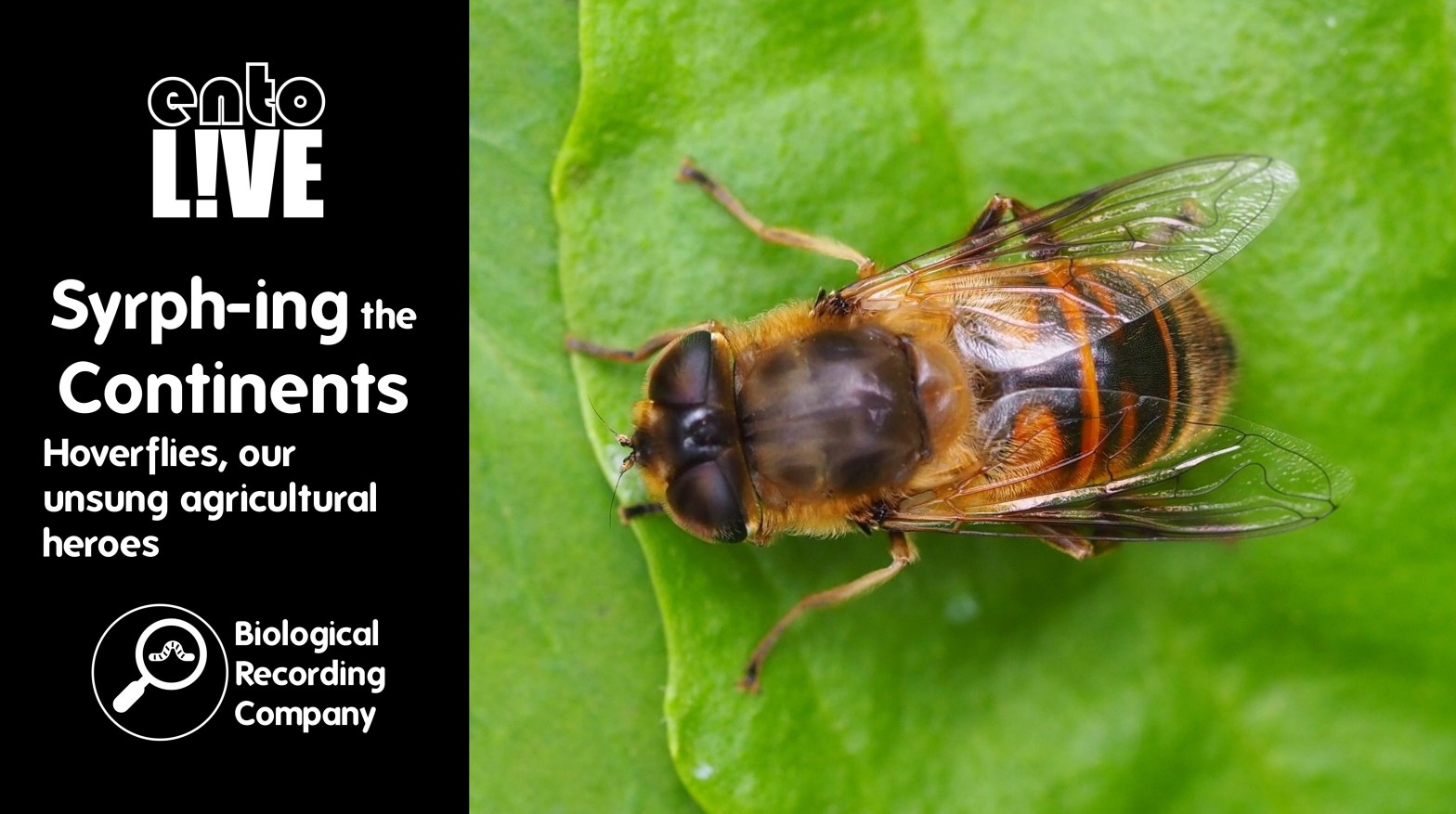
Syrphidae, commonly known as hover flies or flower flies, are an important family of true flies. This talk explored the diverse ecosystem services these flies provide throughout their life cycle, from pest control to pollination. A major focus is on hoverflies’ remarkable ability to migrate long distances, distributing these services across vast geographic areas.
While many questions remain about the migratory behaviour of species within this family, recent advances in technology and research methods are discussed that offer promising new insights. These developments give us hope for what lies ahead in uncovering the secrets of these small but mighty insects.
Q&A with Samm Reynolds
Samm Reynolds is a PhD candidate at the University of Guelph in Ontario, Canada. She studies native pollinator conservation in agriculture throughout southern Ontario and has a particular interest in native bees and syrphids (hover flies). Her goal is to understand pollinator-habitat interactions at a species level and to bring this research to the public through education campaigns and pushing for improved pollinator protection policy.
1. How far do hoverflies migrate?
The longest distance recorded for single hoverfly migration, based on stable isotope analysis, is a staggering 3,000 kilometres. This puts the maximum distance observed for hoverfly migration on par with that observed for the migration of dragonflies and butterflies. Remember that wind plays a crucial role in facilitating such long-distance movement – these migrations are definitely not entirely self-propelled! Such long-distance migration is far from the case for all hoverfly migrations, of course, and research generally suggests that the distance migrated is highly variable both between and within species.
2. Do both sexes of hoverflies migrate?
There is evidence to suggest that it is predominantly female hoverflies who migrate, or at least who migrate the furthest. There are definitely some males that migrate, but evidence shows that they aren’t as well equipped for long distant flying. This is because females are often more cold tolerant and also utilise something called ‘oogenesis-flight syndrome’ whereby they build up fat deposits rather than developing their ovaries which gives them long-term endurance for long-distance flights. When collecting hoverflies mid-migration, whilst the exact sex ratio varies by species, ratios are most often skewed towards females, especially at the “end point” of their migration.
3. How can we make agricultural habitats more welcoming for hoverflies?
The primary recommendation that we are making for agriculture right now is to maintain semi-natural habitats as part of farmland. Features like hedgerows are immensely useful for hoverflies, as are piles of rotting wood (which should ideally be left out, rather than cleared away), as are diverse local floral resources, as are forest edges. It is often feasible to conserve these features even on intensely farmed plots of land by constructing and maintaining them on marginal land, small pockets and along field boundaries. It’s also recommended to provide flowering resources for the entire season, hoverflies may not often stray too far and so having access to floral resources for their whole life cycle within a fairly small radius is really important.
Literature References
- Reynolds et al. (2024) ‘A comprehensive review of long-distance hover fly migration (Diptera: Syrphidae)’: https://resjournals.onlinelibrary.wiley.com/doi/full/10.1111/een.13373
- Jeekel and Overbeek (1968) ‘A migratory flight of hover-flies (Diptera, Syrphidae) observed in Austria. Beaufortia’: https://repository.naturalis.nl/pub/505147/BEAU1968015196001.pdf
- Shannon (1926) ‘A preliminary report on the seasonal migrations of insects’: https://www.jstor.org/stable/pdf/25004127.pdf
- Menz et al. (2019) ‘Quantification of migrant hoverfly movements (Diptera: Syrphidae) on the West coast of North America’: https://royalsocietypublishing.org/doi/pdf/10.1098/rsos.190153
- Stefanescu et al. (2013) ‘Multi-generational long-distance migration of insects: studying the painted lady butterfly in the Western Palaearctic’: https://nora.nerc.ac.uk/id/eprint/21064/1/N021064PP.pdf
- Jia et al. (2022) ‘Windborne migration amplifies insect-mediated pollination services’: https://elifesciences.org/articles/76230.pdf
- Kanazawa et al. (2015) ‘First migration record of chestnut Tiger butterfly, Parantica sita niphonica (Moore, 1883) (Lepidoptera: Nymphalidae: Danainae) from Japan to Hong Kong and longest recorded movement by the species’: https://bioone.org/journals/The-Pan-Pacific-Entomologist/volume-91/issue-1/2014-91.1.091/First-migration-record-of-Chestnut-Tiger-Butterfly-iParantica-sita-niphonica/10.3956/2014-91.1.091.short
- Bauer et al. (2024) ‘Monitoring aerial insect biodiversity: A radar perspective’: https://royalsocietypublishing.org/doi/pdf/10.1098/rstb.2023.0113
- Hu et al. (2016) ‘Mass seasonal bioflows of high-flying insect migrants’: https://www.science.org/doi/abs/10.1126/science.aah4379
- Gao et al. (2020) ‘Adaptive strategies of high-flying migratory hoverflies in response to wind currents’: https://royalsocietypublishing.org/doi/full/10.1098/rspb.2020.0406
- Wotton et al. (2019) ‘Mass seasonal migrations of hoverflies provide extensive pollina- tion and crop protection services’: https://www.cell.com/current-biology/pdfExtended/S0960-9822(19)30605-0
- Ouin et al. (2011) ‘Can deuterium stable isotope values be used to assign the geographic origin of an auxiliary hoverfly in south-western France?: Geographic origin of an auxiliary hoverfly’: https://analyticalsciencejournals.onlinelibrary.wiley.com/doi/abs/10.1002/rcm.5127
- Clem et al. (2023) ‘Insights into natal origins of migratory Nearctic hover flies (Diptera: Syrphidae): new evidence from stable isotope (δ 2 H) assignment analyses’: https://nsojournals.onlinelibrary.wiley.com/doi/pdfdirect/10.1111/ecog.06465
- Dällenbach et al. (2018) ‘Higher flight activity in the offspring of migrants compared to residents in a migratory insect’: https://royalsocietypublishing.org/doi/pdf/10.1098/rspb.2017.2829
- Massy et al. (2021) ‘Hoverflies use a time-compensated sun compass to orientate during autumn migration’: https://royalsocietypublishing.org/doi/full/10.1098/rspb.2021.1805
- Svensson and Janzon (1984) ‘Why does the hoverfly Metasyrphus corollae migrate?’: https://resjournals.onlinelibrary.wiley.com/doi/abs/10.1111/j.1365-2311.1984.tb00856.x
- Clem et al. (2022) ‘Do Nearctic hover flies (Diptera: Syrphidae) engage in long-distance migration? An assessment of evidence and mechanisms’: https://esajournals.onlinelibrary.wiley.com/doi/pdf/10.1002/ecm.1542
- Hart and Bale (1997) ‘Cold tolerance of the aphid predator Episyrphus balteatus (DeGeer) (Diptera, Syrphidae)’: https://resjournals.onlinelibrary.wiley.com/doi/abs/10.1111/j.1365-3032.1997.tb01177.x
- Hondelmann and Poehling (2007) ‘Diapause and overwintering of the hoverfly Episyrphus balteatus’: https://onlinelibrary.wiley.com/doi/abs/10.1111/j.1570-7458.2007.00568.x
- Doyle et al. (2022) ‘Genome-wide transcriptomic changes reveal the genetic pathways involved in insect migration’: https://onlinelibrary.wiley.com/doi/pdf/10.1111/mec.16588
- Francuski et al. (2013) ‘Landscape genetics and spatial pattern of phenotypic variation of Eristalis tenax across Europe’: https://onlinelibrary.wiley.com/doi/abs/10.1111/jzs.12017
- Hondelmann et al. (2005) ‘Restriction fragment length polymorphisms of different DNA regions as genetic markers in the hoverfly Episyrphus balteatus (Diptera: Syrphidae)’: https://www.cambridge.org/core/journals/bulletin-of-entomological-research/article/abs/restriction-fragment-length-polymorphisms-of-different-dna-regions-as-genetic-markers-in-the-hoverfly-episyrphus-balteatus-diptera-syrphidae/C1CD4F21556C1F978808841AF4BD24DC
- Raymond et al. (2013) ‘Lack of genetic differentiation between contrasted overwintering strategies of a Major Pest predator Episyrphus balteatus (Diptera: Syrphidae): implications for biocontrol’: https://journals.plos.org/plosone/article/file?id=10.1371/journal.pone.0072997&type=printable
- Raymond et al. (2013) ‘Migration and dispersal may drive to high genetic variation and significant genetic mixing: The case of two agriculturally important, continental hoverflies (Episyrphus balteatus and Sphaerophoria scripta)’: https://journals.plos.org/plosone/article/file?id=10.1371/journal.pone.0072997&type=printable
- Liu et al. (2019) ‘Genome-wide developed microsatellites reveal a weak population differentiation in the hoverfly Eupeodes corollae (Diptera: Syrphidae) across China’: https://journals.plos.org/plosone/article/file?id=10.1371/journal.pone.0215888&type=printable
- Davis et al. (2023) ‘Crop-pollinating Diptera have diverse diets and habitat needs in both larval and adult stages’: https://esajournals.onlinelibrary.wiley.com/doi/pdf/10.1002/eap.2859
- Orford et al. (2015) ‘The forgotten flies: the importance of non-syrphid Diptera as pollinators’: https://royalsocietypublishing.org/doi/full/10.1098/rspb.2014.2934
- Landry and Parrott (2016) ‘Could the lateral transfer of nutrients by outbreaking insects lead to consequential landscape-scale effects?’: https://esajournals.onlinelibrary.wiley.com/doi/pdfdirect/10.1002/ecs2.1265
- Fisler and Marcacci (2022) ‘Tens of thousands of migrating hoverflies found dead on a strandline in the south of France’: https://publications.goettingen-research-online.de/handle/2/125027
- Lv et al. (2023) ‘Changing patterns of the east Asian monsoon drive shifts in migration and abundance of a globally important rice pest’: https://onlinelibrary.wiley.com/doi/pdfdirect/10.1111/gcb.16636
Further Info
- The Most Remarkable Migrants of All: The Fascinating World of Fly Migration entoLIVE: https://biologicalrecording.co.uk/2023/03/13/fly-migration/
- Syrphidae migration video: https://youtu.be/30u0dXZ0bjo
entoLIVE
entoLIVE webinars feature guest invertebrate researchers delving into their own invertebrate research. All events are free to attend and are suitable for adults of all abilities – a passion for invertebrates is all that’s required!
- Donate to entoLIVE: https://www.gofundme.com/f/entolive-2025
- Upcoming entoLIVE webinars: https://www.eventbrite.com/cc/entolive-webinars-74679
- entoLIVE blog: https://biologicalrecording.co.uk/category/entolive-blog/
- entoLIVE on YouTube: https://youtube.com/playlist?list=PLuEBNUcfMmE95Re19nMKQ3iX8ZFRFgUAg&feature=shared
entoLIVE is delivered by the Biological Recording Company in partnership with the British Entomological & Natural History Society, Royal Entomological Society and Amateur Entomologists’ Society, with support from Buglife, Field Studies Council and National Biodiversity Network Trust.
The entoLIVE programme is delivered by Biological Recording Company and receives sponsorship from the following organisations:
- British Entomological & Natural History Society
- Royal Entomological Society
- Amateur Entomogists’ Society
Learn more about British wildlife

 Biological Recording