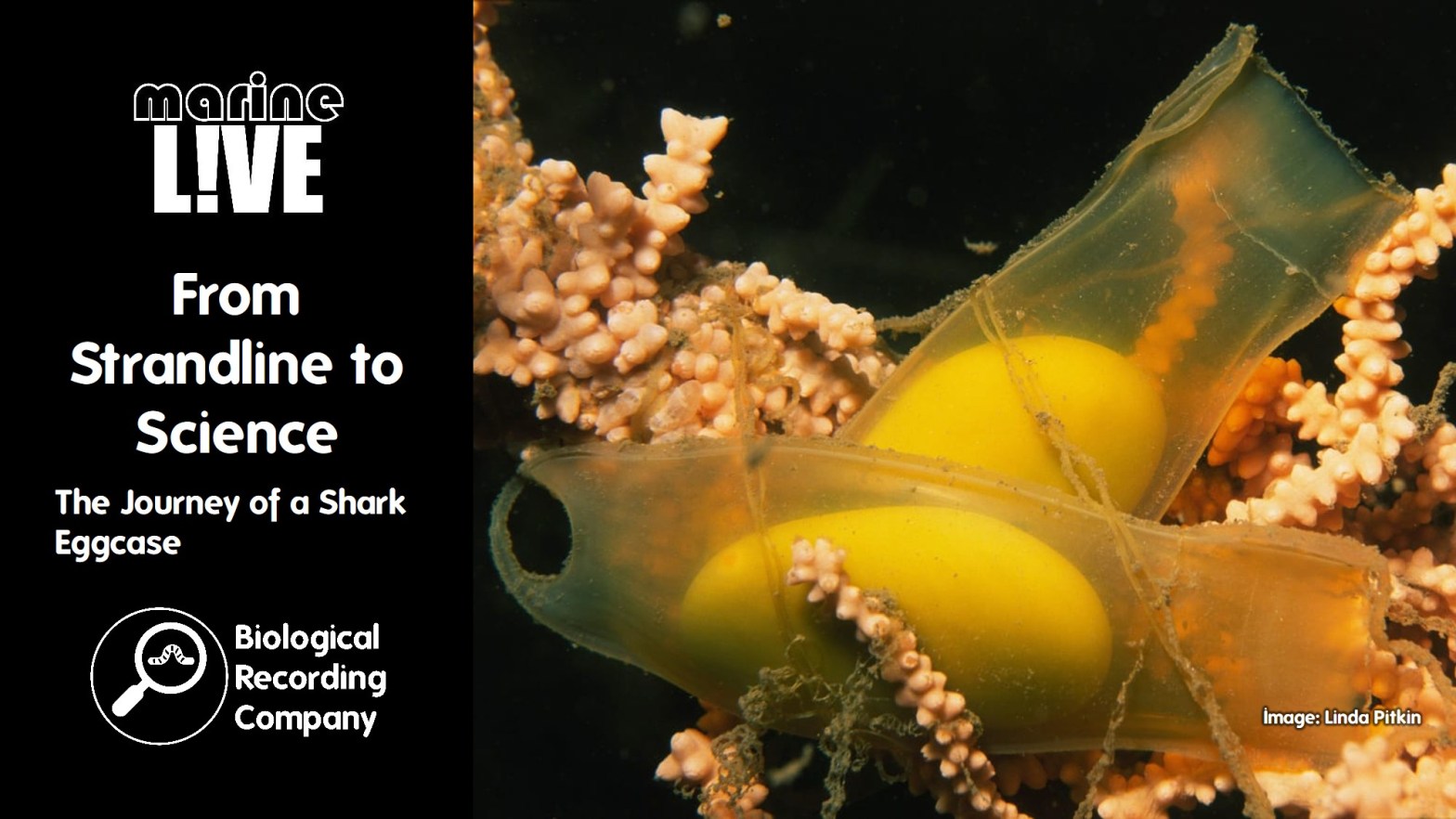
The Great Eggcase Hunt encourages people to get out on the beach in search of mermaids purses – the eggcases of sharks and skate. Each species has a distinct design so, once found, you can identify which species it once belonged to, before recording them to the Shark Trust. Find out how the Great Eggcase Hunt has evolved over the past 22 years, what it has discovered during that time, and how you can get involved as a citizen scientist.
Q&A with Cat Gordon
Cat Gordon is the Senior Conservation Officer at the Shark Trust – a UK conservation charity working globally to safeguard the future of sharks, skates and rays. She leads the Community Engagement programme and is responsible for citizen science initiatives such as the Great Eggcase Hunt and the Basking Shark Project. She’s previously been involved in developing a number of conservation planning documents for highly threatened species, and is now working on developing a new project called Living with Sharks.
1. What triggers eggcases to pop open?
When the developing shark or skate is ready to emerge, the eggcase will naturally open along the top seam (between the upper two horns or upper tendrils). The growth of the embryo within the eggcase causes the capsule to pop open (pre-opening) once the developing shark or skate reaches the appropriate size – almost like they’re bursting out. They will then need to wiggle their way out of the capsule to break free. The eggcase will only ever open naturally along that top seam. If you find an eggcase with a hole or split elsewhere this will have been caused by predation, e.g., by a crab or mollusc, or if washed ashore it could be from a bird pecking the eggcase capsule.
2. What determines the shape and size of an eggcase?
The general shape is determined by which taxonomic family or order it belongs to. There are five orders and 13 families that are oviparous (egg-laying). However, the exact shape and features (e.g. whether there are keels or tendrils) are unique to each species. Skate eggcases are usually square or rectangular in shape, often with a pointed horn on each corner; catshark eggcases are usually oblong shaped, almost like a bowling pin and may have tendrils extending from the corners; horn sharks have spiral shaped eggcases like a corkscrew; carpetsharks are rounder in shape and may have very short horns; and chimaeras are spindle or leaf shaped.
Beyond that, it is also worth noting that environmental conditions (e.g. water temperature) may impact characteristics of the eggcase, particularly size and colour, with the latter being quite variable amongst the eggcases of some species (such as the Smallspotted Catshark). It is also true that the larger species generally have larger eggcases, for example, the Flapper Skate reaches 2-3m in length and its eggcase capsule is amongst the largest that can be found at around 20cm.
3. Is it okay to take eggcases home and keep them?
As far as we know, empty eggcases do not serve a secondary purpose in the seashore environment, unlike seaweed which decomposes and provides vital habitats and food sources for many organisms, as well as contributing to nutrient cycling. In fact, eggcases don’t seem to break down at all, we’ve had many eggcase hunters attempt to compost them in home compost bins, but they come out the same as they go in! We therefore believe it’s acceptable to take empty eggcases home if you wish to and if anything, it will prevent duplicate counting if someone finds and reports that same eggcase after you. That being said, if taking part in the Great Eggcase Hunt, you never have to collect the eggcases, and so it is always personal choice.
If you do wish to collect eggcases, make sure you are 100% certain they are empty. Admittedly, the shark/skate embryo inside doesn’t stand a good chance of surviving once its eggcase has washed up on the beach, but there is always a chance so we’d advice that you return any you suspect have content to the sea, ideally anchored down in a secure spot.
4. Is it worth uploading photos of eggcases that you saw several years ago?
Absolutely! If you’ve got photos of an eggcase with a reliable date and location, you can record it to the Great Eggcase Hunt at www.sharktrust.org/greateggcasehunt or via the Shark Trust citizen science app, regardless of when it was from. You can also submit eggcases from anywhere in the world!
5. What are the main threats to sharks and rays in British waters?
The main threat to sharks and rays is overfishing. That is true irrespective of which part of the ocean they are in. Globally, a third of all sharks, rays and chimaeras are threatened with extinction risk, and this is primarily due to overfishing. Sharks are inherently vulnerable as they are long lived, late to mature, and produce few young, meaning they are unable to replenish their populations quickly. In addition, many sharks and rays are highly migratory and so may cross multiple country borders. International collaboration is therefore required through international fishing agreements and coordination through Regional Fishery Management Organisation bodies to ensure they are suitably managed across their range. There are other threats to sharks and rays, such as habitat destruction and pollution, but they are secondary to overfishing.
Literature References
- Ellis et al. (2024) ‘The distribution of the juvenile stages and eggcases of skates (Rajidae) around the British Isles’: https://onlinelibrary.wiley.com/doi/abs/10.1002/aqc.4149
- Gordon et al. (2016) ‘Descriptions and revised key to the eggcases of the skates (Rajiformes: Rajidae) and catsharks (Carcharhiniformes: Scyliorhinidae) of the British Isles’: https://www.mapress.com/zt/article/view/zootaxa.4150.3.2
Further Info
- Shark Trust: www.sharktrust.org
- Great Eggcase Hunt: www.sharktrust.org/greateggcasehunt
- Eggcase ID guidance: https://www.sharktrust.org/geh-id
- Eggcase training guides: https://www.sharktrust.org/geh-training
- Eggcase Recording Hub: https://recording.sharktrust.org/ (App Store: https://apps.apple.com/sr/app/the-shark-trust/id159770154; Google Play Store: https://play.google.com/store/apps/details?id=org.sharktrust.sharktrust&gl=GB)
- The Great Eggcase Hunt Celebrating 20 Years! report: https://www.sharktrust.org/Handlers/Download.ashx?IDMF=c6b91890-428b-41f9-98e9-db73a86ff20a&_gl=1*1mmmkdf*_up*MQ..*_gs*MQ..&gclid=CjwKCAjwup3HBhAAEiwA7euZug_TbK-OG9S8JwQ6zFUrR2ik_Fc_5YoMA59kjtILehrFwWYbP1eejxoCFNgQAvD_BwE&gbraid=0AAAAADLDCVUJ-5t-os8sDwO7WGseLvxb_
- FSC WildID fold-out guide for shark and ray egg cases: https://www.nhbs.com/shark-and-skate-eggcases-book
- Important Shark and Ray Areas (ISRAs) E-Atlas: https://sharkrayareas.org/e-atlas/
marineLIVE
marineLIVE webinars feature guest marine biologists talking about their research into the various organisms that inhabit our seas and oceans, and the threats that they face. All events are free to attend and are suitable for adults of all abilities – a passion for marine life is all that’s required!
- Upcoming marineLIVE webinars: https://www.eventbrite.co.uk/cc/marinelive-webinars-3182319
- Donate to marineLIVE: https://gofund.me/fe084e0f
- marineLIVE blog: https://biologicalrecording.co.uk/category/marinelive-blog/
- marineLIVE on YouTube: https://youtube.com/playlist?list=PLuEBNUcfMmE-t2dzcoX59iR41WnEf21fg&feature=shared
marineLIVE is delivered by the Biological Recording Company with funding from the British Ecological Society.
- Explore upcoming events and training opportunities from the Biological Recording Company: https://www.eventbrite.co.uk/o/the-biological-recording-company-35982868173
- Check out the British Ecological Society website for more information on membership, events, publications and special interest groups: https://www.britishecologicalsociety.org/
Learn more about British wildlife



 Biological Recording